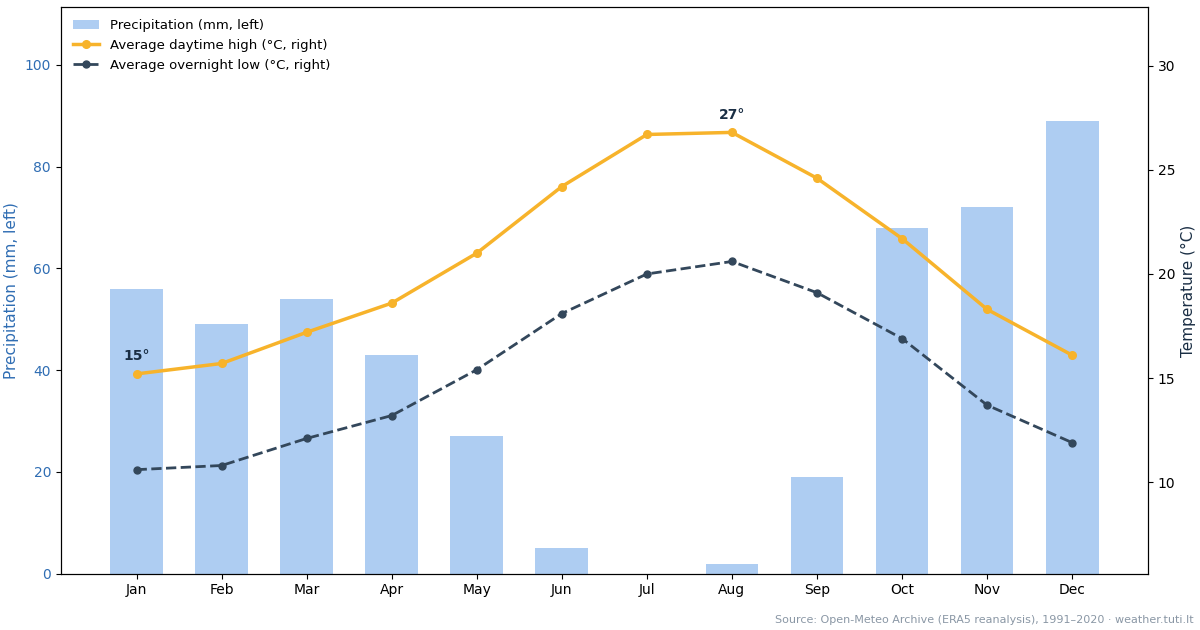
Read the table as follows: the daytime high is the average of all daily maximums for that month across 1991–2020, the overnight low the average of all daily minimums, and the wet-day share the fraction of days with at least 1 mm. For the week ahead, use the live Faro forecast.
| Month | Avg. daytime high | Avg. overnight low | Avg. precipitation | Days with ≥1 mm | Daylight |
|---|---|---|---|---|---|
| January | 15.2 °C | 10.6 °C | 56 mm | 24% | 9.9 h |
| February | 15.7 °C | 10.8 °C | 49 mm | 20% | 10.8 h |
| March | 17.2 °C | 12.1 °C | 54 mm | 22% | 12.0 h |
| April | 18.6 °C | 13.2 °C | 43 mm | 19% | 13.2 h |
| May | 21.0 °C | 15.4 °C | 27 mm | 15% | 14.2 h |
| June | 24.2 °C | 18.1 °C | 5 mm | 3% | 14.7 h |
| July | 26.7 °C | 20.0 °C | 0 mm | 1% | 14.4 h |
| August | 26.8 °C | 20.6 °C | 2 mm | 1% | 13.5 h |
| September | 24.6 °C | 19.1 °C | 19 mm | 9% | 12.4 h |
| October | 21.7 °C | 16.9 °C | 68 mm | 22% | 11.2 h |
| November | 18.3 °C | 13.7 °C | 72 mm | 25% | 10.2 h |
| December | 16.1 °C | 11.9 °C | 89 mm | 25% | 9.7 h |
Atlantic latitude, African sun
The Algarve sits at the same latitude as the Mediterranean's hot spots but faces the open Atlantic, and the difference shows up in two places: the water temperature (cool, clear, refreshing well into summer) and the wind pattern (afternoon sea breezes that keep the beach comfortable when inland Portugal is roasting). Sunshine is the headline: summer months are nearly rain-free and reliably bright.
Rain is concentrated in the November–February stretch, when Atlantic fronts sweep across — the one caveat for winter-sun planning.
June to September: beach season
June averages 24.2 °C by day with just 5 mm of rain; July and August peak at 26.7 °C and 26.8 °C with essentially no rain (0 mm and 2 mm). Nights stay mild (20.0 °C in July). The famous grotto trips at Benagil, the Ria Formosa's sandbar islands and the cliff coves all run at full tilt.
August is the busiest and warmest month on the water; July is nearly identical with slightly thinner crowds. Either way, book ahead — the Algarve's resort towns are built for this window and fill accordingly.
The golden shoulders: May–June and September–October
May averages 21.0 °C and September 24.6 °C — warm enough for beach afternoons, cool enough for the Seven Hanging Valleys trail, Ria Formosa kayak days or Tavira's lanes without melting. October (21.7 °C) is the last reliable beach-adjacent month; the first Atlantic fronts usually arrive mid-month (68 mm).
For hikers, golfers and cyclotourists this stretch is the Algarve's best-kept deal: resort prices soften, the light goes golden, and the sea is at its warmest on the September side.
November to April: the winter-sun season
Winter is mild and mostly bright: highs of 18.3 °C in November easing to 15.2 °C in January, with nights rarely below 10.6 °C. The rain arrives in frontal spells — November averages 72 mm and December 89 mm — but dry, shirt-sleeve afternoons are common between them.
This is the season that made the Algarve a golf and long-stay destination: quiet resorts, open courses, and prices a fraction of summer's. Pack a rain shell and treat the hourly forecast as the daily planner.
So, when should you go?
- Beach-first traveller: July–August for heat and buzz; September for warm sea and softer crowds.
- Walker, golfer, cyclist: May–June or late September–October, or any winter month between fronts.
- Winter sun: December–February with realistic expectations — mild and bright, not tropical.
- Family trip on a budget: first half of June or the last week of August into September.