Read the table as follows: the daytime high is the average of all daily maximums for that month across 1991–2020, the overnight low the average of all daily minimums, and the wet-day share the fraction of days with at least 1 mm. For the actual week, the live Amsterdam forecast is the tool.
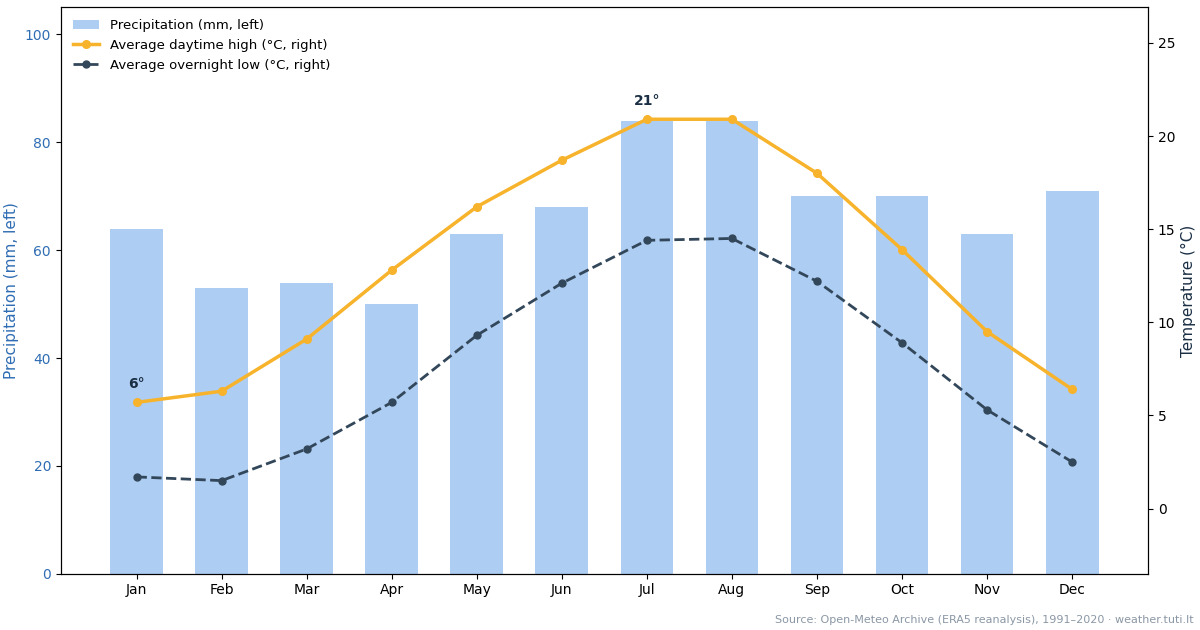
| Month | Avg. daytime high | Avg. overnight low | Avg. precipitation | Days with ≥1 mm | Daylight |
|---|---|---|---|---|---|
| January | 5.7 °C | 1.7 °C | 64 mm | 41% | 8.3 h |
| February | 6.3 °C | 1.5 °C | 53 mm | 38% | 9.9 h |
| March | 9.1 °C | 3.2 °C | 54 mm | 37% | 11.9 h |
| April | 12.8 °C | 5.7 °C | 50 mm | 37% | 14.0 h |
| May | 16.2 °C | 9.3 °C | 63 mm | 36% | 15.8 h |
| June | 18.7 °C | 12.1 °C | 68 mm | 40% | 16.7 h |
| July | 20.9 °C | 14.4 °C | 84 mm | 44% | 16.2 h |
| August | 20.9 °C | 14.5 °C | 84 mm | 43% | 14.6 h |
| September | 18.0 °C | 12.2 °C | 70 mm | 40% | 12.7 h |
| October | 13.9 °C | 8.9 °C | 70 mm | 41% | 10.6 h |
| November | 9.5 °C | 5.3 °C | 63 mm | 43% | 8.8 h |
| December | 6.4 °C | 2.5 °C | 71 mm | 42% | 7.8 h |
A North Sea city with a rain habit
Amsterdam sits barely above sea level, an hour from the North Sea, and its climate is textbook maritime: changeable, windy and damp at any time of year, with annual precipitation around 794.0 mm spread evenly enough that no month is a safe bet and none is a disaster. Showers are usually brief — the city is designed for ducking into a brown café.
Extremes are rare: the 1991–2020 record spans -14.2 °C to 36.3 °C. What the weather does reliably is mood: light, wind off the water, and long soft evenings.
March to May: the tulip calendar
Spring builds from 9.1 °C in March through 12.8 °C in April — when King's Day turns the city orange and the bulb fields south of Haarlem open — to 16.2 °C in May. The Keukenhof display runs roughly late March to mid-May; mid-April is the classic bulb-fields week.
April showers are a fact of Dutch life; the pay-off is fresh green, blossom along the canals and daylight stretching past 14.0 hours.
June to August: terraces, canals and festivals
June (18.7 °C), July (20.9 °C) and August (20.9 °C) are the canal-side months: terraces on the water, open-air cinema, park afternoons and daylight at midsummer around 16.7 hours. Rain arrives mostly as passing showers (84 mm in July) and a thundery afternoon now and then.
Book canal-side beds early for this stretch — it is the city's high season, and the evening light on the herengracht is the reason.
September to November: golden and quieter
September (18.0 °C) is a connoisseur's month: still mild, calmer streets, museum queues shorter. October (13.9 °C) and November (9.5 mm of rain) turn greyer — good museum weather, and the season when the city's café culture does its best work.
December to February: damp winter, big light
Winter averages highs of 6.4 °C in December and 5.7 °C in January, with overnight lows around 1.7 °C and frost nights common but hard freezes rarer than the postcards of frozen canals suggest. Snow happens; drizzle is more typical. The trade is atmosphere: Christmas lights on the canals, museums without queues and the cheapest beds of the year.
Pack a waterproof layer and wind-proof expectations — and use the hourly strip to slot the canal walk between showers.
So, when should you go?
- Tulips and bulbs: mid-April (with King's Day energy on 27 April) — book months ahead.
- Classic city trip: May–June or September — mild, green, long light.
- Museums and cafés: October–February — grey outside, at its best inside.
- Budget traveller: January–February — the cheapest, quietest weeks; pack waterproofs.