Most "best time to visit" articles answer with vibes. This one answers with 30 years of observations: the monthly normals below come from Lithuanian weather-station records for 1991–2020 (the World Meteorological Organization's standard reference period), and they describe what a typical day in each month actually feels like in Vilnius — not what a brochure hopes it feels like.
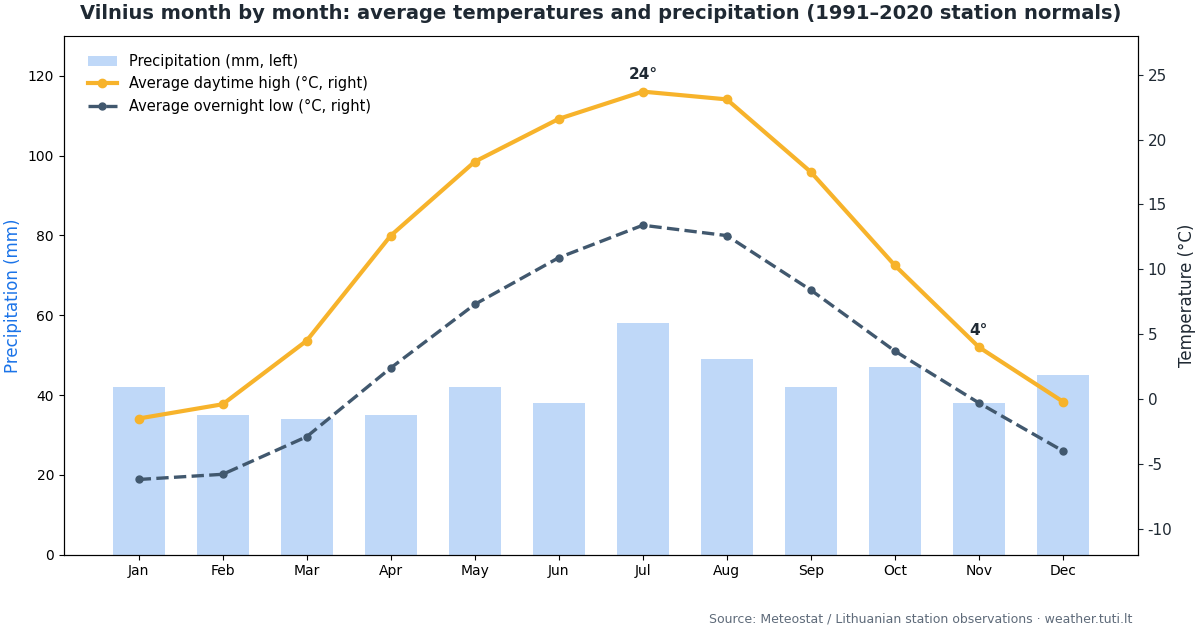
Vilnius weather month by month: the numbers
Read the table as follows: the daytime high is the average of all the daily maximums for that month across 1991–2020, the overnight low the average of all daily minimums, and the wet-day share tells you what fraction of days collect at least 1 mm of rain or melted snow. Individual days will of course swing well beyond these averages — the live Vilnius forecast is where the actual week ahead lives.
| Month | Avg. daytime high | Avg. overnight low | Avg. precipitation | Days with ≥1 mm | Daylight |
|---|---|---|---|---|---|
| January | -1.5 °C | -6.2 °C | 42 mm | 32% | 7.8 h |
| February | -0.4 °C | -5.8 °C | 35 mm | 32% | 9.7 h |
| March | 4.5 °C | -2.9 °C | 34 mm | 26% | 11.7 h |
| April | 12.6 °C | 2.4 °C | 35 mm | 18% | 14.0 h |
| May | 18.3 °C | 7.3 °C | 42 mm | 19% | 16.0 h |
| June | 21.6 °C | 10.9 °C | 38 mm | 19% | 17.3 h |
| July | 23.7 °C | 13.4 °C | 58 mm | 21% | 16.8 h |
| August | 23.1 °C | 12.6 °C | 49 mm | 17% | 15.0 h |
| September | 17.5 °C | 8.4 °C | 42 mm | 18% | 12.8 h |
| October | 10.3 °C | 3.7 °C | 47 mm | 25% | 10.6 h |
| November | 4.0 °C | -0.3 °C | 38 mm | 27% | 8.5 h |
| December | -0.2 °C | -4.0 °C | 45 mm | 34% | 7.3 h |
May and June: mild days, endless evenings
If you want to see Vilnius at its most photogenic, late May and June are hard to beat. The average daytime high climbs from 18.3 °C in May to 21.6 °C in June, overnight values stay above a jacket-and-scarf level for most of the second half of June, and the days stretch to 17.3 hours of daylight at mid-month. Parks and café terraces open up, and the evening light lasts past 22:00. Rain is a real presence (38 mm in June) but typically arrives as showers you can plan around rather than a grey ceiling.
May itself is the gamble: the first half can still deliver single-digit afternoons and a late frost night, so a light mid-layer earns its place in the bag even on a sunny forecast.
July and August: warmest — and wettest
July averages a daytime high of 23.7 °C and August 23.1 °C, with nights that rarely dip below 12 °C. This is beach-on-the-lake weather, open-air cinema and the festival season. The catch is moisture: July averages 58 mm, the wettest month of the year, and much of it falls in short, heavy bursts — convective showers and the occasional thunderstorm that build on hot afternoons. A compact rain shell matters more here than in any other month; the reward is that the air clears quickly afterwards.
August quietly fixes July's one flaw. It is nearly as warm (23.1 °C) but a third drier (49 mm), and the light turns golden earlier in the day. For many locals, late August is the single nicest fortnight of the year.
September and October: golden, quiet, and cooling fast
September starts feeling like a second summer — a 17.5 °C average high on the first days — and ends firmly in autumn. For city breaks, this is a strong choice: fewer tour groups, amber-golden foliage in the parks, and comfortable walking temperatures. October cools quickly (10.3 °C average high, 3.7 °C overnight) and the first frosts usually arrive; pack for mornings near zero even if the afternoon looks mild in the forecast.
Our October 2026 data recap shows exactly how much one October can deviate from these normals — +3.4 °C in that case — which is why we re-check the forecast as the trip approaches instead of trusting the monthly average alone.
November to April: the long, cold, atmospheric half
From November the averages go below or near freezing and the daylight shrinks to 7.3 hours in December. January is the coldest month (average high -1.5 °C, average low -6.2 °C), and while spectacular cold snaps happen, most winter days sit a few degrees either side of zero with slush, refreeze and occasional proper snow cover. If you come for the Christmas market, late December's short days and candle-lit streets are part of the charm; if you come for architecture photography, the low winter sun actually gives you dramatic light — just dress for it (see our November packing guide for the layering logic).
March and April are shoulder months with a split personality: averages rise from 4.5 °C to 12.6 °C, but snow showers and 20 °C afternoons both remain possible, sometimes in the same week.
So, when should you go?
- First visit, warm-weather traveller: late June to August — long days, the full terrace season, plan around shower bursts.
- City-break optimist: May or September — mild, greener or golden, quieter.
- Christmas-market pilgrim: December — dark and cold by design; bring real winter kit.
- Budget traveller who doesn't mind grey: November and February — cheapest rooms of the year, and the fewest hours to fit sightseeing into.
Whichever month you choose, the last step is the same: check the actual forecast a few days before you fly. The Vilnius forecast page shows the next 48 hours hour by hour (hourly strip), a 16-day outlook and a live rain radar (radar card) — enough to move your museum day under the one rainy afternoon rather than into it.