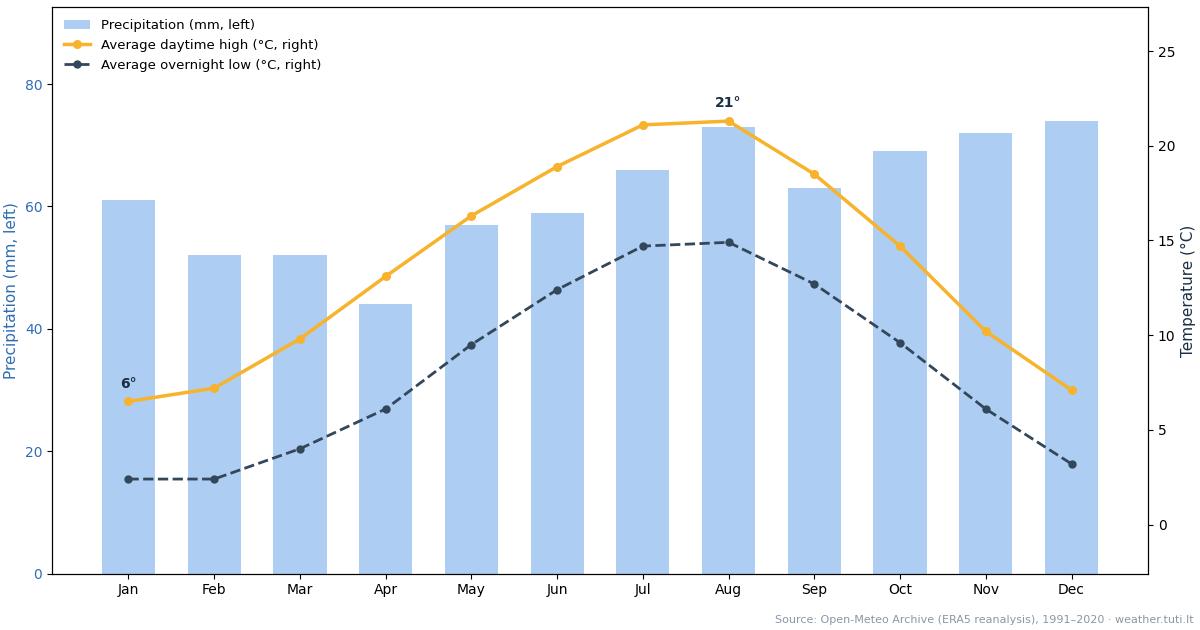
Read the table as follows: the daytime high is the average of all daily maximums for that month across 1991–2020, the overnight low the average of all daily minimums, and the wet-day share is the fraction of days collecting at least 1 mm of rain. Belgium's maritime climate rarely does anything to extremes — the live Bruges forecast shows the actual week ahead.
| Month | Avg. daytime high | Avg. overnight low | Avg. precipitation | Days with ≥1 mm | Daylight |
|---|---|---|---|---|---|
| January | 6.5 °C | 2.4 °C | 61 mm | 41% | 8.5 h |
| February | 7.2 °C | 2.4 °C | 52 mm | 38% | 10.0 h |
| March | 9.8 °C | 4.0 °C | 52 mm | 36% | 11.9 h |
| April | 13.1 °C | 6.1 °C | 44 mm | 35% | 13.9 h |
| May | 16.3 °C | 9.5 °C | 57 mm | 36% | 15.6 h |
| June | 18.9 °C | 12.4 °C | 59 mm | 36% | 16.5 h |
| July | 21.1 °C | 14.7 °C | 66 mm | 38% | 16.0 h |
| August | 21.3 °C | 14.9 °C | 73 mm | 39% | 14.5 h |
| September | 18.5 °C | 12.7 °C | 63 mm | 36% | 12.6 h |
| October | 14.7 °C | 9.6 °C | 69 mm | 41% | 10.7 h |
| November | 10.2 °C | 6.1 °C | 72 mm | 45% | 8.9 h |
| December | 7.1 °C | 3.2 °C | 74 mm | 45% | 8.0 h |
A flat, coastal, grey-tolerant climate
Bruges sits barely 12 m above sea level about an hour's drive from the North Sea, so its weather is textbook maritime: mild for the latitude, changeable, and damp at any time of year. Annual precipitation averages around 742.0 mm — modest by Alpine standards, but spread across nearly every month, which is why locals treat a compact rain shell as everyday clothing.
Extremes are rare: the hottest day in the 1991–2020 record reached 37.5 °C and the coldest -11.3 °C. What the climate does reliably is atmosphere — mist off the canals in the morning, soft grey light on the gables, and the occasional afternoon thunderstorm in summer.
May to August: terraces, canal boats and long evenings
May is the surprise pick: average highs of 16.3 °C, some of the longest daylight of the year (15.6 h), and greenery everywhere. June (18.9 °C) and July (21.1 °C) are the warmest months; June is statistically the driest of the summer trio at about 59 mm.
This is when the canal boats run at full frequency, the lake at Minnewater is at its best, and days stretch to 16.5 hours around midsummer. Rain arrives mostly as short showers and passing fronts — carry a shell, check the hourly strip, and plan the Belfry climb for a dry window.
September and October: mist, gold and quieter lanes
September stays mild (18.5 °C average high) and is one of the calmer months for crowds; October cools to 14.7 °C and turns reliably golden. Rain ticks up (69 mm in October, 72 mm in November, peaking at 74 mm in December), but so does the mood: low sun through morning mist on an empty canal is the photograph people come home with.
November to February: the Christmas-market months
Bruges' famous winter procession — the Christmas market, the ice rink on the Markt, the shops full of chocolate — runs from mid-November into the new year, and the weather cooperates by being properly wintry without being extreme: highs of 7.1 °C in December and 6.5 °C in January, with overnight lows a few degrees below freezing and frost on roughly a third of winter nights.
Snow does fall — enough to dust the towers a few times each winter — but lasting white cover is the exception rather than the rule, and grey drizzle is more likely than a snow globe. Pack for damp cold: the canals rarely freeze hard enough to skate, and the wind off the North Sea cuts through fashion coats. The pay-off is that a hot chocolate beside the Markt at 16:30, with the lights already on, is a genuine seasonal experience.
March and April: the quiet shoulder
March averages 9.8 °C by day and April 13.1 °C, with the latter one of the drier months (44 mm) and the days lengthening fast. This is a good time to pair Bruges with Ghent or the coast before the crowds thicken, and tulip season in the region begins to open.
So, when should you go?
- First visit, classic trip: May, June or September — mild, green, long days, manageable crowds.
- Christmas-market pilgrim: mid-November to early January — dark by design, bring a real coat.
- Photographer: October and March — mist, low light, thinner crowds.
- Budget traveller: January and February — the cheapest beds of the year and a city you nearly have to yourself.