Read the table as follows: the daytime high is the average of all daily maximums for that month across 1991–2020, the overnight low the average of all daily minimums, and the wet-day share the fraction of days with at least 1 mm. For the week ahead, use the live Tokyo forecast.
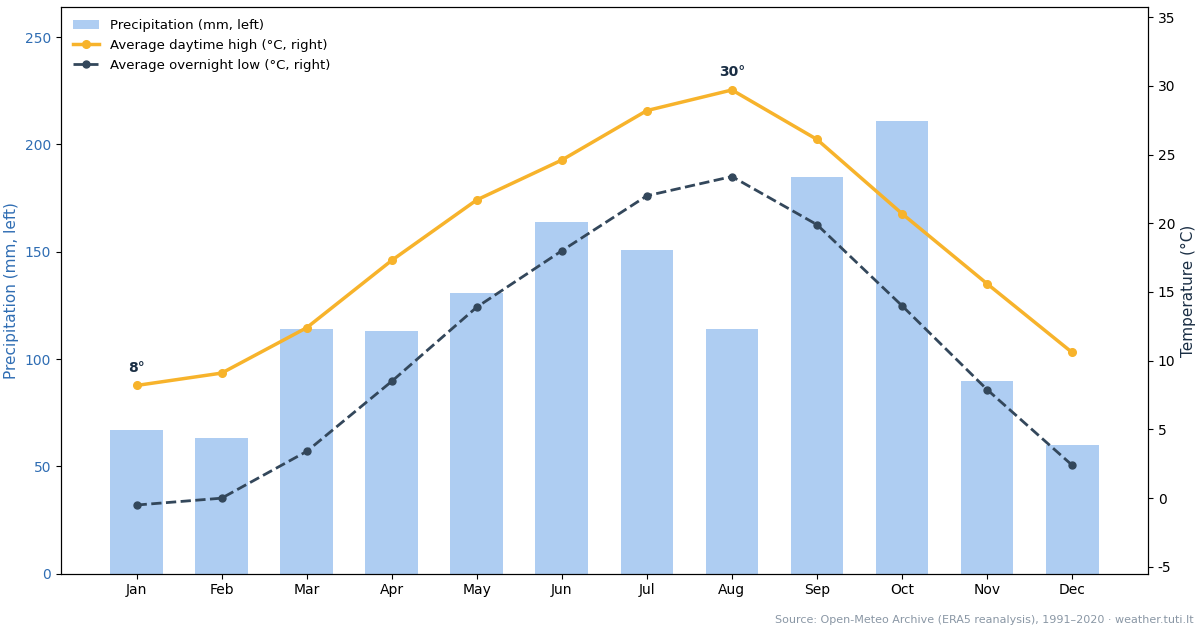
| Month | Avg. daytime high | Avg. overnight low | Avg. precipitation | Days with ≥1 mm | Daylight |
|---|---|---|---|---|---|
| January | 8.2 °C | -0.5 °C | 67 mm | 22% | 10.0 h |
| February | 9.1 °C | 0.0 °C | 63 mm | 27% | 10.9 h |
| March | 12.4 °C | 3.4 °C | 114 mm | 38% | 12.0 h |
| April | 17.3 °C | 8.5 °C | 113 mm | 38% | 13.1 h |
| May | 21.7 °C | 13.9 °C | 131 mm | 38% | 14.0 h |
| June | 24.6 °C | 18.0 °C | 164 mm | 46% | 14.5 h |
| July | 28.2 °C | 22.0 °C | 151 mm | 43% | 14.3 h |
| August | 29.7 °C | 23.4 °C | 114 mm | 36% | 13.5 h |
| September | 26.1 °C | 19.9 °C | 185 mm | 46% | 12.4 h |
| October | 20.7 °C | 14.0 °C | 211 mm | 42% | 11.3 h |
| November | 15.6 °C | 7.9 °C | 90 mm | 33% | 10.3 h |
| December | 10.6 °C | 2.4 °C | 60 mm | 24% | 9.8 h |
A four-act climate
Japan's main island runs a four-act year: a crisp, mostly dry winter with sun on the mountains; a spring that the entire country schedules around; a rainy early summer (tsuyu) followed by humid heat; and an autumn so photogenic the maples have their own tourism. Typhoons brush the archipelago most often in August and September, mostly affecting days rather than weeks.
Tokyo sits on the Pacific side, which shapes its rain: the tsuyu front and late-summer storms dominate, while winter is surprisingly dry and sunny for a major city at this latitude.
March to May: blossom and green
Tokyo's spring averages 12.4 °C by day in March, 17.3 °C in April and 21.7 °C in May, with nights that still need a layer in March (3.4 °C). The famous cherry trees typically open around the last week of March in Tokyo and pass their peak in early April — the exact week varies every year, so track the blossom forecast rather than the calendar.
May is arguably the month for first-timers: 21.7 °C highs, fresh green everywhere, rain still moderate (131 mm) and the whole country outdoors before the tsuyu arrives.
June to September: rains, humidity and typhoon tails
The tsuyu front parks over Japan from early June into mid-July — Tokyo averages 164 mm and 151 mm across those months, with grey drizzle and sudden downpours. August is the hottest month (29.7 °C average highs with overnight lows near 23.4 °C, and humidity to match); September cools slightly (26.1 °C) but stays storm-prone as typhoon tails pass through.
Summer travel works — Hokkaido and the mountains are superb, and city trips manage with morning starts and indoor middays — but it is the season to respect the hourly forecast and carry rain gear always.
October to February: foliage, crisp air, quiet winter
October (20.7 °C) and November (15.6 °C) are the second golden window: dry, stable air, the maple season sweeping south — Kyoto's temples peak from mid-November into early December. December (10.6 °C) turns cold and bright; January (8.2 °C) and February (9.1 °C) are Tokyo's crisp, dry winter with occasional blustery days and rare snow.
Winter is the budget traveller's season: flight and hotel prices dip, the sky is often startlingly blue, and the mountain snow country — for skiers — is at its best while Tokyo stays mostly rain-free.
Kyoto compared
Kyoto sits in a basin ringed by hills, which exaggerates both ends: summer afternoons run hotter than Tokyo's (August average high 31.1 °C) and winter nights colder (January average low -0.2 °C), with occasional snow turning the temple gardens into the postcard Japan. Spring and autumn there are the reason the words 'seasonal' and 'Japan' travel together.
| Month | Avg. high | Avg. low | Avg. rain | Days with ≥1 mm |
|---|---|---|---|---|
| January | 7.6 °C | -0.2 °C | 64 mm | 25% |
| February | 8.5 °C | -0.1 °C | 72 mm | 32% |
| March | 12.4 °C | 2.5 °C | 122 mm | 40% |
| April | 17.9 °C | 7.5 °C | 133 mm | 39% |
| May | 22.7 °C | 12.7 °C | 155 mm | 38% |
| June | 26.0 °C | 17.4 °C | 211 mm | 49% |
| July | 29.5 °C | 22.0 °C | 240 mm | 56% |
| August | 31.1 °C | 23.0 °C | 137 mm | 42% |
| September | 26.9 °C | 19.2 °C | 189 mm | 43% |
| October | 21.1 °C | 13.0 °C | 166 mm | 32% |
| November | 15.6 °C | 7.1 °C | 84 mm | 25% |
| December | 10.0 °C | 2.0 °C | 66 mm | 25% |
So, when should you go?
- Blossom trip: the last week of March into the first week of April (book a year ahead for Tokyo and Kyoto).
- Maple trip: mid-October to late November, south-to-north as the season moves.
- First visit outside peak: May — green, mild, pre-rains.
- Budget or ski-bound traveller: December–February — dry, crisp cities and the best snow in the Alps of Japan.