Read the table as follows: the daytime high is the average of all daily maximums for that month across 1991–2020, the overnight low the average of all daily minimums, and the wet-day share the fraction of days with at least 1 mm. For the week ahead, use the live Kraków forecast.
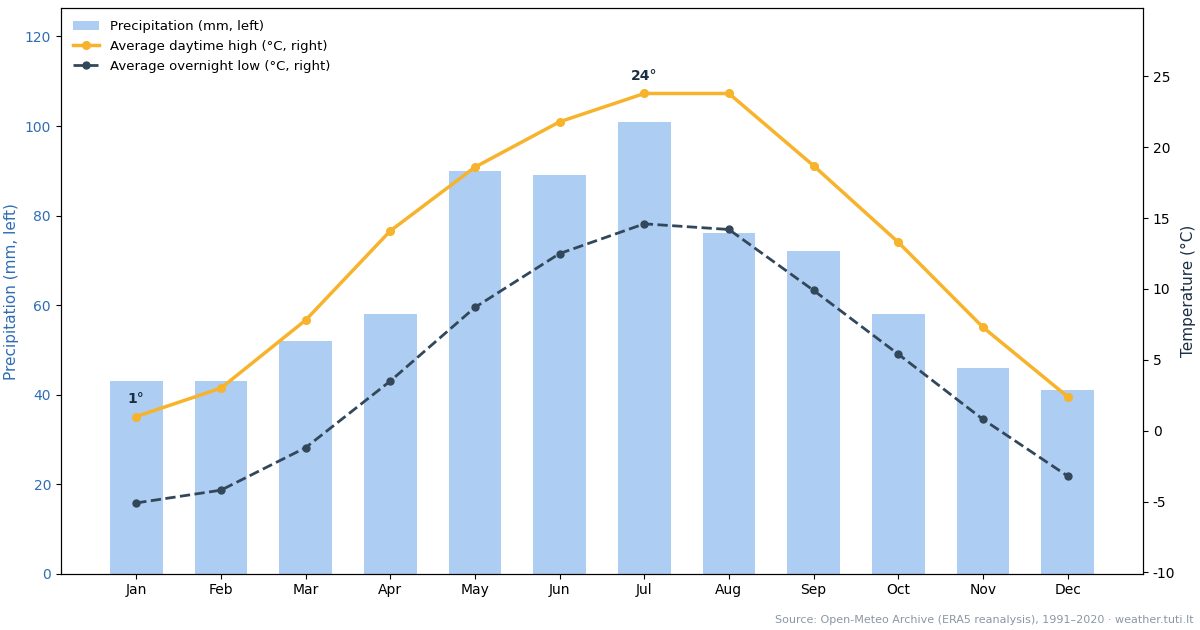
| Month | Avg. daytime high | Avg. overnight low | Avg. precipitation | Days with ≥1 mm | Daylight |
|---|---|---|---|---|---|
| January | 1.0 °C | -5.1 °C | 43 mm | 35% | 8.6 h |
| February | 3.0 °C | -4.2 °C | 43 mm | 37% | 10.1 h |
| March | 7.8 °C | -1.2 °C | 52 mm | 38% | 11.9 h |
| April | 14.1 °C | 3.5 °C | 58 mm | 37% | 13.8 h |
| May | 18.6 °C | 8.7 °C | 90 mm | 46% | 15.4 h |
| June | 21.8 °C | 12.5 °C | 89 mm | 45% | 16.3 h |
| July | 23.8 °C | 14.6 °C | 101 mm | 45% | 15.9 h |
| August | 23.8 °C | 14.2 °C | 76 mm | 36% | 14.4 h |
| September | 18.7 °C | 9.9 °C | 72 mm | 35% | 12.6 h |
| October | 13.3 °C | 5.4 °C | 58 mm | 34% | 10.7 h |
| November | 7.3 °C | 0.8 °C | 46 mm | 33% | 9.1 h |
| December | 2.4 °C | -3.2 °C | 41 mm | 32% | 8.1 h |
A continental city in a basin
Kraków sits on the Vistula upriver from the German plain, close enough to the Carpathian foothills that its climate leans continental: warm (occasionally hot) summers, cold winters with real snow, and spring–autumn transitions that can swing ten degrees inside a week. The city's position in a shallow valley matters in winter — cold, stagnant air can pool and trap smoke from coal and wood heating, which is why winter air quality makes the local news.
The record spread in the 1991–2020 data says it plainly: from -29.1 °C to 35.2 °C. Pack for both ends if you travel in the shoulders.
May to August: the square season
May (18.6 °C) and June (21.8 °C) are the easiest months: warm days, cool nights (8.7 °C in May), long light (16.3 h at midsummer) and the Rynek Główny — Europe's largest medieval square — in full terrace mode. July (23.8 °C) is the warmest month, and the wettest (101 mm): summer heat builds the afternoon thunderstorms that Polish summer is known for.
August (23.8 °C) is nearly as warm with slightly less rain (76 mm) — a good compromise for heat-averse travellers, and the month the Wieliczka salt mine stays a blissful constant 15 °C whatever the surface does.
September and October: golden Kraków
September is the insider's month: 18.7 °C average highs, stable air, the Planty park ring turning gold. October cools fast (13.3 °C by day, 5.4 °C at night) with the first frosts — the month of morning mist over the Vistula and chestnut leaves on the cobbles.
For photographers and café-sitters this stretch rivals anywhere on this blog; bring a warm layer and let the week-ahead forecast pick the bright days.
November to March: the snowy, smoky season
November is grey and damp (7.3 °C); winter proper runs December to February with highs of 2.4 °C, 1.0 °C and 3.0 °C and nights well below freezing (-5.1 °C in January). Snow is a genuine presence — the old town under snow is exactly the postcard — and December's Christmas market on the Rynek is the winter draw.
The honest caveat: cold, windless spells can trap heating smoke in the basin and push fine-particle pollution to unhealthy levels; check the air-quality reading on the forecast page alongside the weather, and favour the crisp, windy days for long walks.
So, when should you go?
- First visit, square-and-salt-mine trip: May, June or September — warm, bright, civilised.
- Christmas-market pilgrim: December — frost, mulled wine, real winter kit; watch the air-quality badge.
- Budget traveller: November, January, February — the cheapest beds and the truest winter.
- Photographer: October — mist, gold, empty lanes.