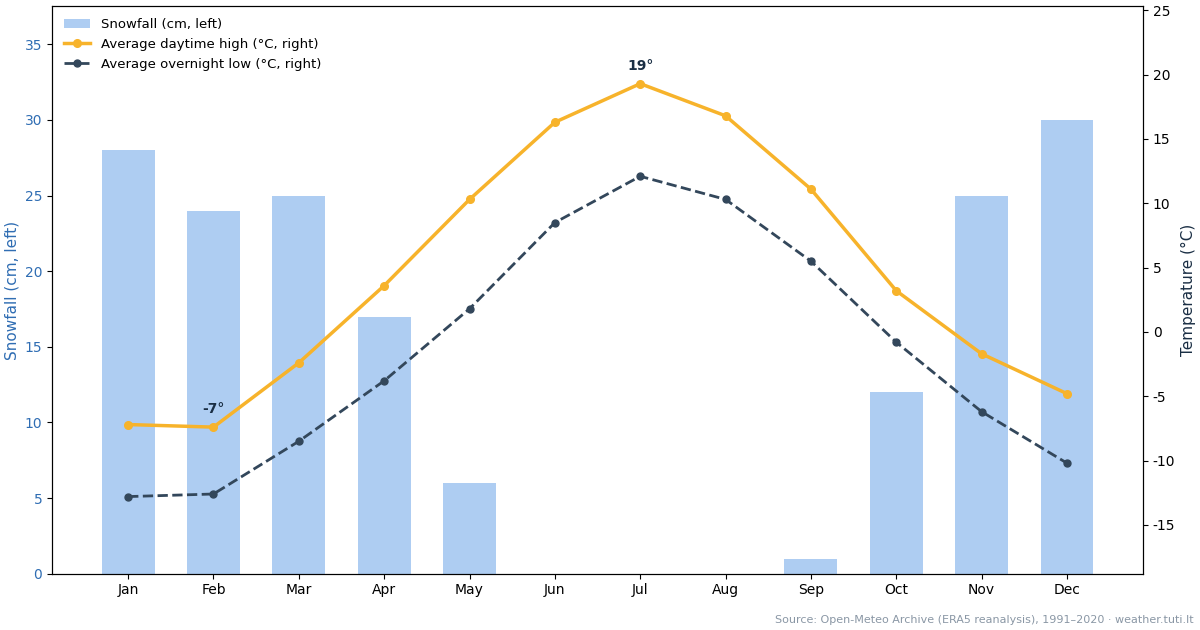
Read the table as follows: values describe Rovaniemi (about 90 m elevation on the Arctic Circle); the daytime high is the average of all daily maximums for the month across 1991–2020, the overnight low the average of all daily minimums. Tromsø's comparison table follows below. The live Rovaniemi forecast is the tool for the actual week.
| Month | Avg. daytime high | Avg. overnight low | Avg. precipitation | Days with ≥1 mm | Daylight |
|---|---|---|---|---|---|
| January | -7.2 °C | -12.8 °C | 37 mm | 31% | 4.4 h |
| February | -7.4 °C | -12.6 °C | 30 mm | 29% | 8.1 h |
| March | -2.4 °C | -8.5 °C | 33 mm | 26% | 11.8 h |
| April | 3.6 °C | -3.8 °C | 34 mm | 27% | 15.5 h |
| May | 10.3 °C | 1.8 °C | 51 mm | 33% | 19.6 h |
| June | 16.3 °C | 8.5 °C | 70 mm | 40% | 23.8 h |
| July | 19.3 °C | 12.1 °C | 81 mm | 41% | 21.4 h |
| August | 16.8 °C | 10.3 °C | 70 mm | 37% | 16.9 h |
| September | 11.1 °C | 5.5 °C | 56 mm | 35% | 13.1 h |
| October | 3.2 °C | -0.8 °C | 52 mm | 32% | 9.5 h |
| November | -1.7 °C | -6.2 °C | 48 mm | 37% | 5.7 h |
| December | -4.8 °C | -10.2 °C | 43 mm | 35% | 2.7 h |
The cold is the co-star, not the villain
Rovaniemi's December average high of -4.8 °C is survivable; the average overnight low of -10.2 °C is where the trip is won or lost. January is the true depth of winter — lows average -12.8 °C, and cold snaps dive far below the median (the record in the 1991–2020 data reaches -40 °C). Dry, still Arctic cold at −15 °C feels cleaner than Atlantic −5 °C, but only in the right clothing.
The kit rule is simple and non-negotiable: insulated boots, a real parka, mittens (not gloves), and layers that come off indoors. Every serious Lapland operator rents thermal suits — take the rental even if you own winter kit, because Arctic-grade insulation is a different product.
The snow: built by Christmas, deepest by March
The white season is not a December surprise — it is engineered from October–November (28.0 cm in November alone) and topped up through winter: 24.0 cm in December, 25.0 cm in January and 17.0 cm in February, with the snowpack reaching its deepest around March. Snow on the ground is effectively continuous from November into April.
That is why the Christmas trips work: husky and reindeer safaris, snowmobiling and the Santa Claus Village's winter trails all run on a snowpack that is already there — not on a weather gamble. For the deepest-powder version of the same trip, target February–March, when daylight is returning (February averages 8.1 hours) and the cold has eased a little.
The light: three-hour days and the polar night
December daylight in Rovaniemi averages 2.7 hours around the solstice — a blue-grey twilight sky for most of the 'day', with sunrise around 11:00 and sunset before 14:00. Travellers either find this magical or suffocating; the honest advice is to plan outdoor activities in the middle-of-day window and treat the rest as aurora, sauna and dinner time.
Tromsø, 350 km further north, crosses the line entirely: the polar night runs from late November to mid-January, when the sun never climbs above the horizon. December there averages -3.9 °C by day and -9.0 °C at night with 42.0 cm of snow — a different, darker, more dramatic version of the same trip, and one where the aurora has more stage and less competition.
The aurora: odds, not promises
The auroral zone sits directly over both towns, so on any clear, dark night the odds are genuinely good — the limiting factor is cloud, not activity. The winter strategy is to allow several nights, book aurora tours with flexible re-booking, and remember that activity happens whenever the sky opens: 21:00 is not more magnetic than 02:00.
The moon matters less in Lapland than elsewhere because December's darkness is so long; the snow, ironically, is the best ally — a white ground doubles the perceived brightness of a modest display.
So, when should you go?
- The classic Christmas trip: mid-December — full snowpack, minimum light, maximum atmosphere; book a year ahead.
- Aurora-first traveller: February–early March — returning daylight, deep snow, long dark nights still.
- Cold-averse visitor: late March–April — milder (March highs around -2.4 °C), longer days, winter sports still live.
- Midnight-sun chaser: the mirror season — June–July, when the same arithmetic runs in reverse.
Tromsø compared, month by month
The table below is Tromsø's counterpart: note the heavier December snow (42.0 cm vs Rovaniemi's 24.0 cm), the similar cold, and the daylight column's collapse to zero through the polar night. Both towns share the same trip logic — the choice is between Rovaniemi's Santa logistics (airport, village, safaris) and Tromsø's fjord-and-mountains drama.
| Month | Avg. high | Avg. low | Avg. rain | Days with ≥1 mm |
|---|---|---|---|---|
| January | -5.7 °C | -10.8 °C | 108 mm | 48% |
| February | -5.6 °C | -10.4 °C | 94 mm | 51% |
| March | -2.5 °C | -7.4 °C | 103 mm | 51% |
| April | 2.2 °C | -3.0 °C | 86 mm | 49% |
| May | 7.1 °C | 1.5 °C | 91 mm | 52% |
| June | 12.1 °C | 6.5 °C | 92 mm | 51% |
| July | 16.2 °C | 10.3 °C | 91 mm | 47% |
| August | 14.9 °C | 9.3 °C | 102 mm | 50% |
| September | 10.5 °C | 5.5 °C | 124 mm | 58% |
| October | 3.7 °C | -0.5 °C | 129 mm | 55% |
| November | -1.4 °C | -6.3 °C | 96 mm | 50% |
| December | -3.9 °C | -9.0 °C | 106 mm | 50% |