Read the table as follows: values describe the valley floor near Lauterbrunnen (about 800 m); the car-free villages of Wengen (1,274 m) and Mürren (1,650 m) sit several degrees cooler in summer and much colder in winter, and the Jungfraujoch station at 3,454 m lives in a different climate altogether. The live Lauterbrunnen forecast covers the valley for the week ahead.
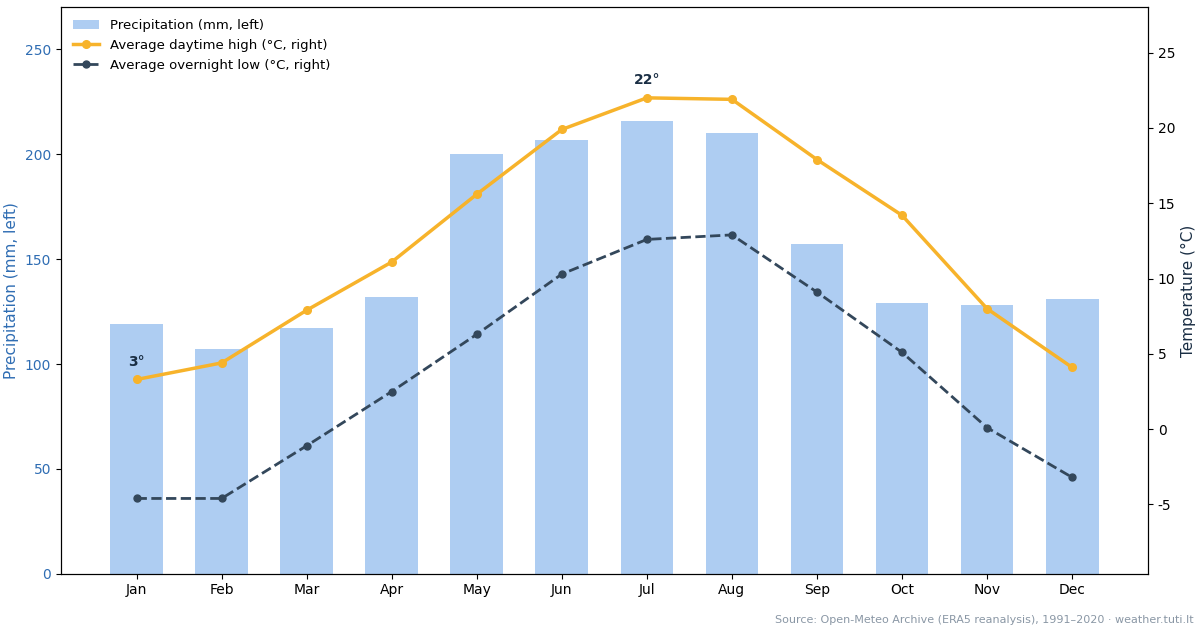
| Month | Avg. daytime high | Avg. overnight low | Avg. precipitation | Days with ≥1 mm | Daylight |
|---|---|---|---|---|---|
| January | 3.3 °C | -4.6 °C | 119 mm | 43% | 9.0 h |
| February | 4.4 °C | -4.6 °C | 107 mm | 43% | 10.3 h |
| March | 7.9 °C | -1.1 °C | 117 mm | 47% | 11.9 h |
| April | 11.1 °C | 2.5 °C | 132 mm | 51% | 13.6 h |
| May | 15.6 °C | 6.3 °C | 200 mm | 63% | 15.0 h |
| June | 19.9 °C | 10.3 °C | 207 mm | 65% | 15.8 h |
| July | 22.0 °C | 12.6 °C | 216 mm | 63% | 15.4 h |
| August | 21.9 °C | 12.9 °C | 210 mm | 58% | 14.1 h |
| September | 17.9 °C | 9.1 °C | 157 mm | 51% | 12.5 h |
| October | 14.2 °C | 5.1 °C | 129 mm | 42% | 10.9 h |
| November | 8.0 °C | 0.1 °C | 128 mm | 46% | 9.4 h |
| December | 4.1 °C | -3.2 °C | 131 mm | 45% | 8.6 h |
One valley, several climates
Alpine weather works vertically: for every hundred metres you climb, temperature drops by roughly half a degree to a degree, and the Jungfrau massif makes its own clouds and wind. A T-shirt afternoon at the valley floor can coincide with fresh snow at the top station, and the famous narrow valley amplifies both — its walls hold the morning shade, channel the afternoon updrafts and let the waterfalls roar loudest after heavy rain.
This is also the region where reanalysis averages are least trustworthy: a grid cell blends valley and mountainside. Use the table as the valley baseline, then check mountain-specific forecasts and webcams before committing to any high route — the Jungfraujoch forecast page is a good start.
June to September: the valley at full volume
Summer is when Lauterbrunnen delivers its famous picture: Staubbach Falls at full flow, meadow-cutting done, every lift and mountain railway running. Valley highs average 19.9 °C in June, 22.0 °C in July and 21.9 °C in August, with nights cool enough for a duvet (12.6 °C average in July).
The catch is convective rain: July averages 216 mm, the wettest month of the year, and most of it falls in dramatic afternoon thunderstorms over the peaks. The working rhythm for hikers is Alpine-standard — first cable car up, ridgeline by ten, below the treeline by two. On stormy afternoons the valley waterfalls only get better, so the weather rarely wastes the day.
December to March: snow season
Winter turns the region into its second, snowier self: Wengen and Mürren open their ski seasons, the Eiger Trail country goes quiet under snow, and the valley floor averages highs of 4.1 °C in December, 3.3 °C in January and 4.4 °C in February, with overnight lows near -4.6 °C in the depths of January.
Inversions are a winter speciality: cold, foggy air can pool in the valley while the terraces above sit in sunshine, which is one reason skiers ride up out of the murk. The high railway to the Jungfraujoch runs year-round, but on storm days it can sit in cloud with nothing to see — check the summit webcams before spending the fare.
The shoulder months: beautiful and awkward
May and November are the between-seasons months: spring is gorgeous (meadows greening, waterfalls swollen by snowmelt) but several lifts and mountain routes are still closed, while November averages 128 mm and 8.0 °C by day with the whole region in maintenance mode. Both are fine for quiet, cheap valley stays and valley-floor walks; neither is the month for a once-in-a-lifetime mountain itinerary.
April is similarly transitional, with average highs of 11.1 °C and lingering snow above — some years it is the best skiing month of the spring, others it is brown and bare. Check the seasonal opening calendar before booking.
So, when should you go?
- Waterfalls and hiking: late June to September — everything open; start mornings early around July's storm pattern.
- Skiing and snow: January to March — most reliable snow with lengthening days.
- Photography on a budget: late May or October — dramatic skies, empty paths, reduced timetables.
- Once-in-a-lifetime summit day (Jungfraujoch): any month can work; build slack into the itinerary and watch the high-station forecast.