Read the table as follows: the daytime high is the average of all daily maximums for that month across 1991–2020, the overnight low the average of all daily minimums, and the wet-day share is the fraction of days that collect at least 1 mm of rain. Averages are not forecasts — the live Positano forecast is where the actual week ahead lives.
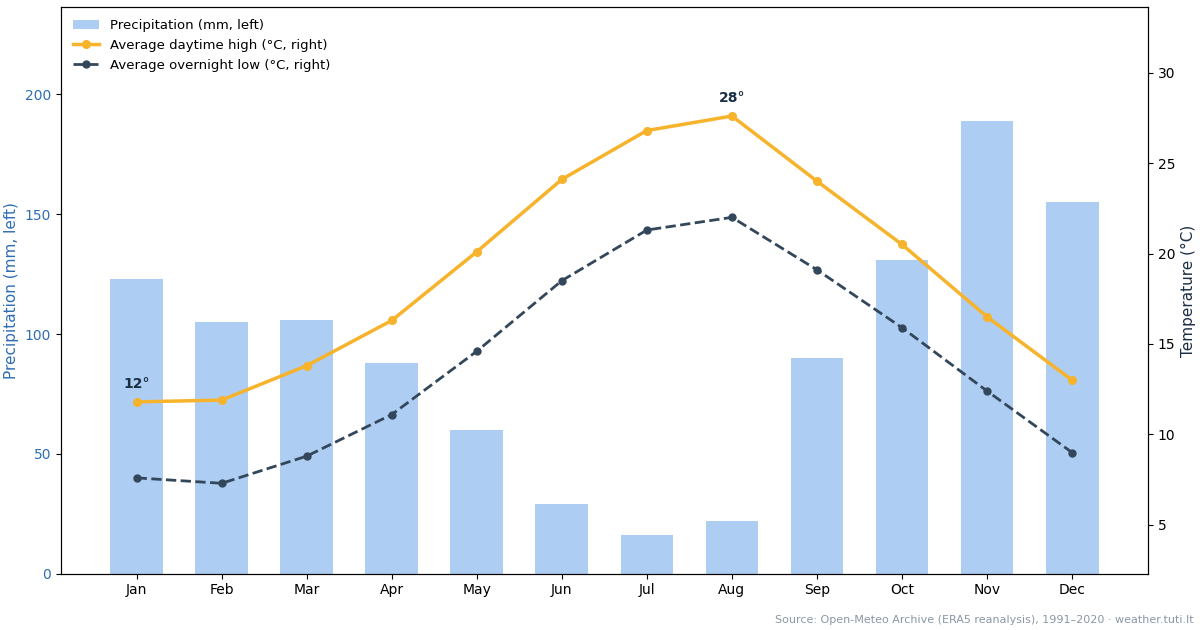
| Month | Avg. daytime high | Avg. overnight low | Avg. precipitation | Days with ≥1 mm | Daylight |
|---|---|---|---|---|---|
| January | 11.8 °C | 7.6 °C | 123 mm | 38% | 9.6 h |
| February | 11.9 °C | 7.3 °C | 105 mm | 40% | 10.7 h |
| March | 13.8 °C | 8.8 °C | 106 mm | 34% | 12.0 h |
| April | 16.3 °C | 11.1 °C | 88 mm | 38% | 13.3 h |
| May | 20.1 °C | 14.6 °C | 60 mm | 26% | 14.5 h |
| June | 24.1 °C | 18.5 °C | 29 mm | 17% | 15.0 h |
| July | 26.8 °C | 21.3 °C | 16 mm | 10% | 14.7 h |
| August | 27.6 °C | 22.0 °C | 22 mm | 13% | 13.8 h |
| September | 24.0 °C | 19.1 °C | 90 mm | 28% | 12.5 h |
| October | 20.5 °C | 15.9 °C | 131 mm | 34% | 11.1 h |
| November | 16.5 °C | 12.4 °C | 189 mm | 45% | 9.9 h |
| December | 13.0 °C | 9.0 °C | 155 mm | 43% | 9.3 h |
A vertical town changes the arithmetic
Positano stacks its pastel houses down a cliff in tiers, so every errand involves stairs. On a 27.6 °C August afternoon, the walk from the beach to the upper town is real exercise, and the buses that crawl the SS163 coast road are packed exactly when the heat is worst. Weather and logistics are the same question here: the combination of heat and crowds, not heat alone, is what makes August exhausting.
The sea helps: an afternoon breeze usually reaches the terraces, and the water itself is at its warmest from late July through September. Ferry season matters too — the boats from Salerno, Naples and Sorrento that make the coast bearable run at full frequency roughly from April into October, then wind down.
May and June: the coast at its best
May opens the season properly: an average daytime high of 20.1 °C, rain already down to 60 mm across the month, and long daylight (14.5 hours) that turns an evening passeggiata into the main event. June is a touch warmer (24.1 °C) and drier still (29 mm).
Both months are swimmable without being sauna-like — the sea is still cool in May and properly pleasant by late June — and the town's famous steps are manageable before the midday peak. This is also the best window for the Path of the Gods ridge walk above the coast: clear views, comfortable temperatures, and none of July's exposure problem.
July and August: high season, high heat
July averages a daytime high of 26.8 °C and August 27.6 °C, with the Mediterranean humidity making both feel several degrees hotter on the sheltered beach. The crowds arrive with the heat: the beach is at its tightest and the coast road at its slowest.
If high season is the only option, run your day against the clock: beach or boat in the morning, siesta in the shade at midday, and dinner late when the heat finally lets go. Note that rain barely exists in July (16 mm on average) — the sky is reliably blue, which is exactly the problem at 30 °C.
September and October: the connoisseur's months
September is arguably the single best month on the whole coast: the average high is still 24.0 °C, the sea has kept its summer warmth, the ferries still run their full timetables, and the tour groups have thinned. October keeps days walkable (20.5 °C average high) though the first real autumn rains arrive (131 mm).
For hikers and photographers these two months are the point of the year: the light is lower and warmer, the ridge trails are cool in the morning, and you can swim at lunchtime and hike at four in the afternoon.
November to April: the shutters close
November is the wettest month of the year in Positano (189 mm, rain on roughly 45% of days), and from November into spring many hotels and restaurants close altogether. The winters themselves are mild — December and January still average highs of 13.0 °C and 11.8 °C — but the coast becomes a different, much emptier place: beautiful for a quiet photographic break, awkward for a classic beach-and-ferries holiday.
If a mild, crowd-free Italy is the goal, winter days are real days: expect 9.6 hours of daylight in January and bright, cool afternoons between the rain fronts. Just check opening hours before you book, and lean on the week-ahead forecast to pick your clear ones.
So, when should you go?
- First visit, beach-and-village trip: mid-May to June or September — warm sea, open season, civilised crowds.
- Hiker or photographer: late April–May or October — cool mornings on the ridge paths, golden light.
- Must travel in summer: July–August with early-morning days, pre-booked everything and a boat on your side.
- Escaping winter: a mild but partly shut-down town from November to March — check openings first.