Read the table as follows: the daytime high is the average of all daily maximums for that month across 1991–2020, the overnight low the average of all daily minimums, and the wet-day share the fraction of days with at least 1 mm. For the week ahead, use the live Prague forecast.
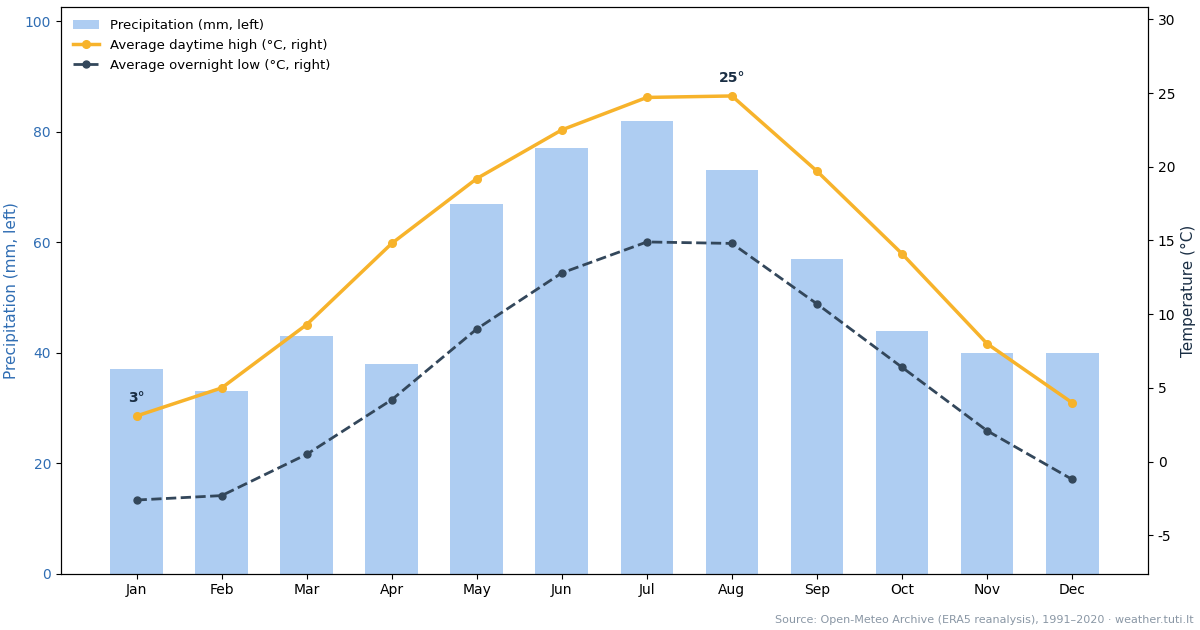
| Month | Avg. daytime high | Avg. overnight low | Avg. precipitation | Days with ≥1 mm | Daylight |
|---|---|---|---|---|---|
| January | 3.1 °C | -2.6 °C | 37 mm | 31% | 8.6 h |
| February | 5.0 °C | -2.3 °C | 33 mm | 30% | 10.1 h |
| March | 9.3 °C | 0.5 °C | 43 mm | 35% | 11.9 h |
| April | 14.8 °C | 4.2 °C | 38 mm | 32% | 13.8 h |
| May | 19.2 °C | 9.0 °C | 67 mm | 41% | 15.4 h |
| June | 22.5 °C | 12.8 °C | 77 mm | 41% | 16.3 h |
| July | 24.7 °C | 14.9 °C | 82 mm | 41% | 15.9 h |
| August | 24.8 °C | 14.8 °C | 73 mm | 35% | 14.4 h |
| September | 19.7 °C | 10.7 °C | 57 mm | 30% | 12.6 h |
| October | 14.1 °C | 6.4 °C | 44 mm | 31% | 10.7 h |
| November | 8.0 °C | 2.1 °C | 40 mm | 30% | 9.1 h |
| December | 4.0 °C | -1.2 °C | 40 mm | 31% | 8.1 h |
A bohemian basin with four real seasons
Prague spreads across hills and river terraces, and its climate is temperate-continental: warm summers with thundery bursts, genuinely cold winters, and long, golden shoulder seasons. The river valley collects morning fog in autumn — atmospheric rather than inconvenient, and usually gone by ten.
The record spread in the 1991–2020 data runs from -25.0 °C to 38.1 °C, so shoulder-season packing means one warm layer and one cool one.
March to May: the city turns green
Spring climbs from 9.3 °C in March through 14.8 °C in April to 19.2 °C in May. April can do everything — blossom, shower, frost night, 22 °C afternoon — often within one week, which is why locals dress in layers until June.
May is the month the beer gardens open properly and Petřín's blossom peaks; daylight runs to 15.4 hours and the crowds have not yet peaked.
June to August: warm, long and thundery
June (22.5 °C), July (24.7 °C) and August (24.8 °C) are the warm months, with midsummer daylight around 16.3 hours. July is also the wettest month (82 mm) — but the rain is mostly afternoon thunder: morning castle, evening beer garden, storm in between is a perfectly normal Prague day.
Heatwaves occasionally push the city past 35 °C; the stone old town holds warmth into the evening, which the riverbank and the beer gardens turn into an amenity.
September and October: golden Prague
September is the connoisseur's month: 19.7 °C average highs, stable air, the St Wenceslas vineyards ripening above the river. October (14.1 °C, nights 6.4 °C) brings the famous valley mists and amber light on the Charles Bridge at dawn — the photograph everyone is really there for.
November to February: frost, mist and markets
November is grey and damp (8.0 °C); December brings the Christmas markets on the Old Town Square with highs near 4.0 °C, frost nights (-1.2 °C) and only 8.1 hours of daylight. January and February (3.1 °C and 5.0 °C highs) are the coldest, cheapest months; snow happens, grey is likelier.
Pack properly — Prague's winter is colder than western European cities at the same trip cost — and let the hourly strip schedule the bridge photographs around the mist.
So, when should you go?
- First visit, bridge-and-castle trip: May, June or September — warm, bright, terraces open.
- Christmas-market pilgrim: December — frost and candles; real winter clothing required.
- Photographer: October — mist, amber light, thinner crowds.
- Budget traveller: January–February — cheapest beds of the year and the truest winter.