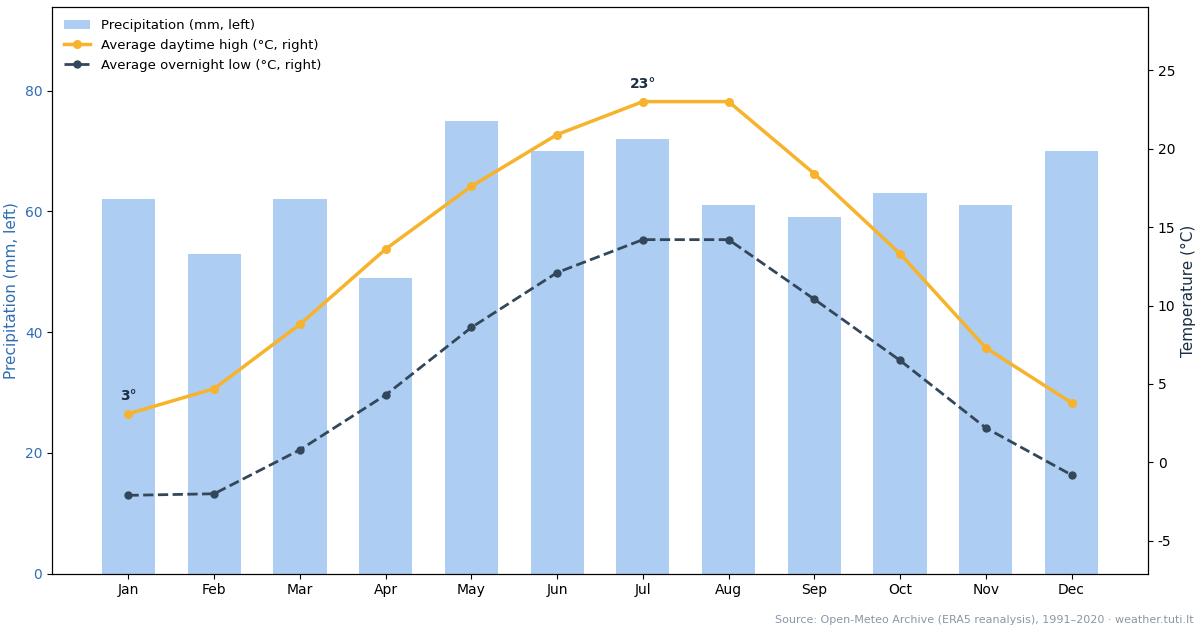
Read the table as follows: the daytime high is the average of all daily maximums for that month across 1991–2020, the overnight low the average of all daily minimums, and the wet-day share the fraction of days with at least 1 mm. For the actual week, use the live Rothenburg forecast.
| Month | Avg. daytime high | Avg. overnight low | Avg. precipitation | Days with ≥1 mm | Daylight |
|---|---|---|---|---|---|
| January | 3.1 °C | -2.1 °C | 62 mm | 39% | 8.7 h |
| February | 4.7 °C | -2.0 °C | 53 mm | 37% | 10.1 h |
| March | 8.8 °C | 0.8 °C | 62 mm | 39% | 11.9 h |
| April | 13.6 °C | 4.3 °C | 49 mm | 36% | 13.8 h |
| May | 17.6 °C | 8.6 °C | 75 mm | 42% | 15.4 h |
| June | 20.9 °C | 12.1 °C | 70 mm | 42% | 16.2 h |
| July | 23.0 °C | 14.2 °C | 72 mm | 43% | 15.8 h |
| August | 23.0 °C | 14.2 °C | 61 mm | 36% | 14.4 h |
| September | 18.4 °C | 10.4 °C | 59 mm | 34% | 12.6 h |
| October | 13.3 °C | 6.5 °C | 63 mm | 37% | 10.8 h |
| November | 7.3 °C | 2.2 °C | 61 mm | 37% | 9.1 h |
| December | 3.8 °C | -0.8 °C | 70 mm | 43% | 8.3 h |
Franconia's plateau climate
Rothenburg sits on a plateau above the Tauber valley in northern Bavaria, far enough inland that its climate has a continental temper: warmer summer afternoons than the Rhine, colder winter nights, and rainfall that arrives mostly as scattered showers and thundery bursts rather than long maritime drizzle. Annual totals are moderate — around 757.0 mm — and no month is reliably wet.
The spread is real: the hottest day in the 1991–2020 record reached 35.2 °C and the coldest -21.1 °C, so spring and autumn trips deserve one warm layer and one cold one.
May to August: terraces, towers and long evenings
May opens the walking season (17.6 °C average high, a dry-ish 75 mm), June reaches 20.9 °C, and July peaks at 23.0 °C — the warmest month, and also the wettest of the summer at 72 mm as afternoon thunderstorms build over the plateau.
Days stretch to 16.2 hours at midsummer, which is exactly what you want here: the full circuit of the town wall at golden hour, the Plönlein without a coach parked in it (early morning, any season), and the night watchman's tour under a dark sky. Rain strategy is simple — the showers pass; the hourly strip tells you which window to swap.
September and October: golden autumn on the Romantic Road
September is the quiet star: 18.4 °C average highs, harvest menus, vineyards on the Tauber turning amber. October cools to 13.3 °C with the first frosts at night (6.5 °C) — fog banks over the valley at dawn, clear afternoons, and the town's Christmas shops already open for early birds.
Autumn is also the coach season's shoulder, so the lanes are calmer than summer while everything stays open. It is arguably the best month-pair for photographers after the Christmas market.
November to February: the candle-lit months
From late November the Reiterlesmarkt fills the market square: wood stalls, mulled wine, and Rothenburg's specialty — a medieval winter scene that can actually deliver frost (-0.8 °C average overnight low in December) and the occasional real snowfall. Highs sit near 3.8 °C in December and 3.1 °C in January, with the year's shortest days (8.3 hours of daylight).
White Christmases happen but are not guaranteed — grey, damp, 2 °C afternoons are just as likely, and lasting snow cover is the exception. Pack for damp cold either way; the market's charm is largely weather-independent, and the year-round Christmas museum covers the sunny-day contingency.
March and April: the thaw shoulder
March averages 8.8 °C by day and April 13.6 °C, with April one of the drier months (49 mm). It is a good time to drive the Romantic Road with the coach crowds absent — though frost nights linger into April, so check the forecast before a spring picnic plan.
So, when should you go?
- First visit, wall-and-lanes trip: May, June or September — warm, green, long evenings.
- Christmas-market pilgrim: late November to late December — book rooms months ahead; bring a real coat.
- Photographer: September–October — golden light, valley fog, quiet mornings.
- Budget traveller: January–February — the cheapest and emptiest weeks, with grey skies the trade-off.