"When can I see the stars in Lithuania?" sounds like an astronomy question. It is mostly a weather question — and it has a data answer. Two things decide whether you see anything on a given night: the Moon (a bright one washes out everything but the Moon itself) and cloud cover (Lithuania sits in the storm track of the North Atlantic, and clouds are the default). The Moon's schedule is predictable years in advance; the clouds are what your forecast is for. This guide puts the two together, with the actual cloud climatology for Vilnius and the upcoming dark-moon windows.
Step 1: pick the dark-moon window
The Moon is the brightest object in the night sky by far, and for about a week on either side of full moon, deep-sky objects — the Milky Way, star clusters, faint nebulae — effectively disappear. The prime observing window runs from about three days before new moon to four days after, when the Moon is either absent or a thin crescent setting early.
| New moon | Dark-sky window (approx.) | Notes |
|---|---|---|
| 9 December 2026 | ~5–14 December | Longest nights of the year; cold-weather kit required |
| 7 January 2027 (20:24 UTC) | ~2–12 January | Same — the deep-winter sky is the darkest |
| 6 February 2027 | ~1–10 February | Days lengthening; evenings still dark early |
(Moon dates follow the US Naval Observatory tables; treat the window edges as ±1 day.)
Step 2: beat the clouds — here is what the data says
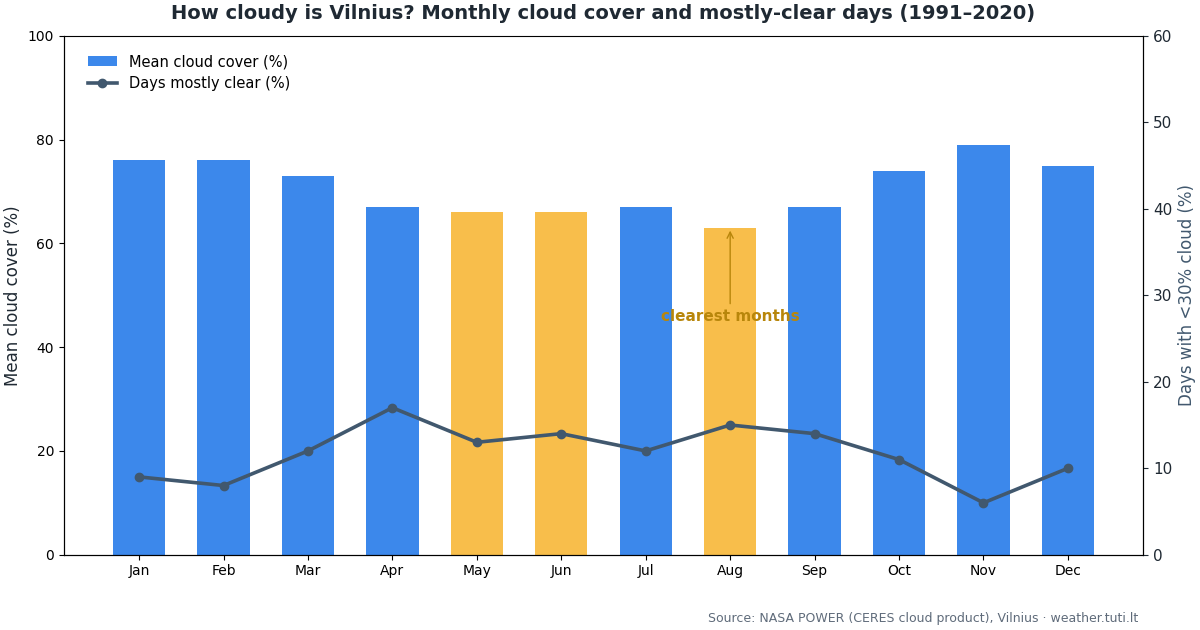
Cloud is the hard part. Averaged over 1991–2020, November is the cloudiest month of the year in Vilnius (79% mean cloud cover) with barely 6% of days qualifying as mostly clear (under 30% cloud). December and January are only marginally kinder (~10% mostly-clear days). The clearer seasons are late spring and summer — August, May, June lead the ranking, with August averaging 63% cloud — which is why August evenings reliably reward periscopes, telescopes and plain lying-on-a-blanket.
Two practical consequences. First, in winter, treat any clear-night forecast as an event to be exploited immediately: with only a handful of mostly-clear days per month, the one that lands in your dark-moon window is the night. Second, high-pressure winter setups in Lithuania often bring not just clear skies but temperature inversions — cold, calm, sometimes fog-prone nights — so a hilltop outside the city can be clearer than a river valley inside it.
Step 3: use the forecast like an astronomer
The forecast page has everything you need in one place:
- The Layers button on the radar card switches the map to a dedicated cloud-cover overlay — available in three altitude bands — so you can see whether the clearing is at low cloud (kills the view) or high cirrus (merely dims it).
- The 16-day outlook (daily list) shows the day-by-day trend: scan the second week of the forecast for the drier, clearer-looking days that line up with the new-moon window.
- The 48-hour strip (hourly view) is for the final call: pick the evening hours with the lowest rain-chance percentage and check the wind — strong wind at the surface usually means cloud is moving through.
- The radar animation on the same card shows the last two hours of real precipitation plus the next half hour — the difference between "clearing now" and "clearing at midnight".
Where and how to watch
Light pollution is the third enemy. Vilnius's glow swamps all but the brightest stars within a few kilometres of the centre; driving 15–30 minutes out of town — in almost any direction away from the city — makes the Milky Way visible on a genuinely dark, clear night. The coastal areas and the eastern lake districts are the traditional dark-sky escapes; what matters more than the exact spot is a low western/northern horizon and distance from the capital's light dome.
In the cold months, remember that stargazing is a low-movement activity in freezing air: our November data shows frost on 44% of nights and average lows around -0.3 °C. Bring more insulation than for a walk — a mat to lie on, a thermos, and double gloves for telescope-fiddling fingers. The November packing guide doubles as a cold-weather observing kit list.
A note on aurora: strong geomagnetic storms occasionally push the auroral oval far enough south for the northern lights to be glimpsed from Lithuania — always during major solar events, always low on the northern horizon, always worth checking a dedicated aurora alert service for. When one is forecast, the same cloud rules apply; the coastal forecast with its sea-effect clouds (see our explainer) is a reminder that the coast can be cloudy when inland is clear.