Read the table as follows: the daytime high is the average of all daily maximums for that month across 1991–2020, the overnight low the average of all daily minimums, and the wet-day share the fraction of days with at least 1 mm of rain. For the actual week, the live Bangkok forecast is the tool.
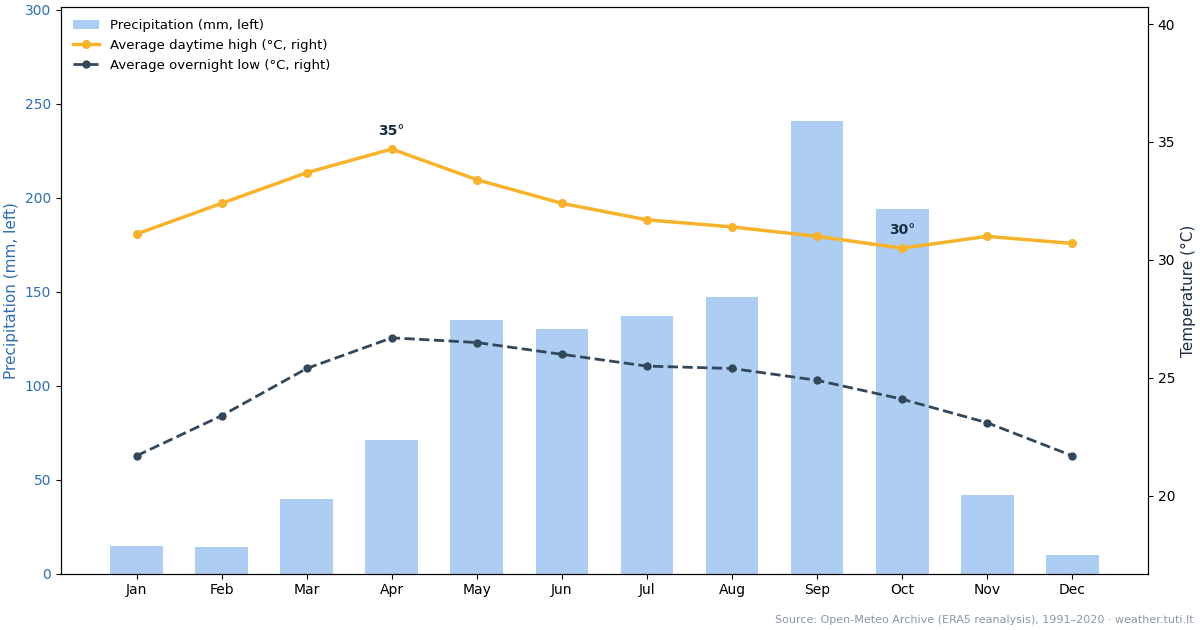
| Month | Avg. daytime high | Avg. overnight low | Avg. precipitation | Days with ≥1 mm | Daylight |
|---|---|---|---|---|---|
| January | 31.1 °C | 21.7 °C | 15 mm | 10% | 11.4 h |
| February | 32.4 °C | 23.4 °C | 14 mm | 11% | 11.7 h |
| March | 33.7 °C | 25.4 °C | 40 mm | 21% | 12.1 h |
| April | 34.7 °C | 26.7 °C | 71 mm | 36% | 12.4 h |
| May | 33.4 °C | 26.5 °C | 135 mm | 66% | 12.8 h |
| June | 32.4 °C | 26.0 °C | 130 mm | 74% | 12.9 h |
| July | 31.7 °C | 25.5 °C | 137 mm | 74% | 12.8 h |
| August | 31.4 °C | 25.4 °C | 147 mm | 77% | 12.6 h |
| September | 31.0 °C | 24.9 °C | 241 mm | 86% | 12.2 h |
| October | 30.5 °C | 24.1 °C | 194 mm | 68% | 11.8 h |
| November | 31.0 °C | 23.1 °C | 42 mm | 21% | 11.5 h |
| December | 30.7 °C | 21.7 °C | 10 mm | 7% | 11.3 h |
Two monsoons, one calendar
Thailand's weather is governed by the south-west monsoon (roughly May to October, wet wind off the Andaman Sea and the Bay of Bengal) and the north-east monsoon (roughly November to February, dry and cooler). Bangkok, on the Gulf's upper reaches, gets the south-west monsoon with a late peak; the Andaman coast gets it straight, with dramatic September–October totals; the Gulf islands in the south take their main rain months from the north-east monsoon instead, around October to December.
The practical consequence: November to February works almost everywhere at once, which is exactly why the country's high season lands there. Outside those months, the right answer depends on which coast you pick.
Bangkok month by month
The cool season is real: December and January average highs of 30.7 °C and 31.1 °C with rain down to 10 mm and 15 mm — temple-hopping weather, and the season for rooftop bars without sweat. February (32.4 °C) is similarly dry and the last easy month.
March to May build the hot season: April tops the year at 34.7 °C average highs with overnight lows near 26.7 °C, and Songkran (mid-April) doubles as the country's biggest water fight for obvious reasons. The monsoon then turns May–October green and stormy, peaking at 241 mm in September; showers tend to arrive as violent late-afternoon bursts rather than all-day rain.
Phuket and the Andaman coast: the monsoon's front line
Phuket takes the south-west monsoon head-on: from May the totals climb, with the year's peak around 310 mm in October and September close behind (290 mm) — rain on roughly 90% of days at the peak. Swimming flags come down on exposed beaches, and boat trips to Phi Phi or Phang Nga run day by day.
From November the same coast is transformed: December through April is dry, sunny and calm, with highs of 27.1 °C–27.5 °C and rain mostly a memory (47 mm in January). If your dates fall in the northern summer, either expect weather-affected boat days or point your beach time at the Gulf side instead.
For the north (Chiang Mai, Chiang Rai), note the February–April 'burning season', when agricultural smoke can sit over the valleys and air quality dips — a reason to favour the north in November–January.
Phuket month by month
| Month | Avg. high | Avg. low | Avg. rain | Days with ≥1 mm |
|---|---|---|---|---|
| January | 26.5 °C | 23.0 °C | 47 mm | 27% |
| February | 27.1 °C | 23.5 °C | 26 mm | 18% |
| March | 27.5 °C | 24.0 °C | 88 mm | 38% |
| April | 27.5 °C | 24.3 °C | 134 mm | 63% |
| May | 27.0 °C | 24.2 °C | 262 mm | 82% |
| June | 26.7 °C | 24.2 °C | 230 mm | 73% |
| July | 26.4 °C | 23.9 °C | 225 mm | 75% |
| August | 26.1 °C | 23.8 °C | 244 mm | 75% |
| September | 25.9 °C | 23.3 °C | 290 mm | 83% |
| October | 25.8 °C | 22.9 °C | 310 mm | 90% |
| November | 26.1 °C | 23.1 °C | 203 mm | 74% |
| December | 26.2 °C | 23.0 °C | 92 mm | 41% |
The contrast with Bangkok is the shape, not the temperature: Phuket barely varies by day (27.5 °C average high in April vs 26.2 °C in December) — what changes is where the rain lands.
So, when should you go?
- First visit, all of Thailand: November to February — the only window that works on every coast.
- Beach-first, Andaman side (Phuket, Krabi, Phi Phi): December to March.
- Beach-first, Gulf side (Samui, Phangan): February to April, or June–September with eyes open.
- Budget or city-only traveller: the monsoon months — green, cheap, dramatic skies, and a working hourly forecast to dodge the downpours.