Read the table as follows: each cell is the average of all daily maximums (or all precipitation totals) for that month across 1991–2020, from reanalysis data at each destination's coordinates. Winter-sun maths is about the combination: high by day, rain when you least want it, and how far the heat dips after dark.
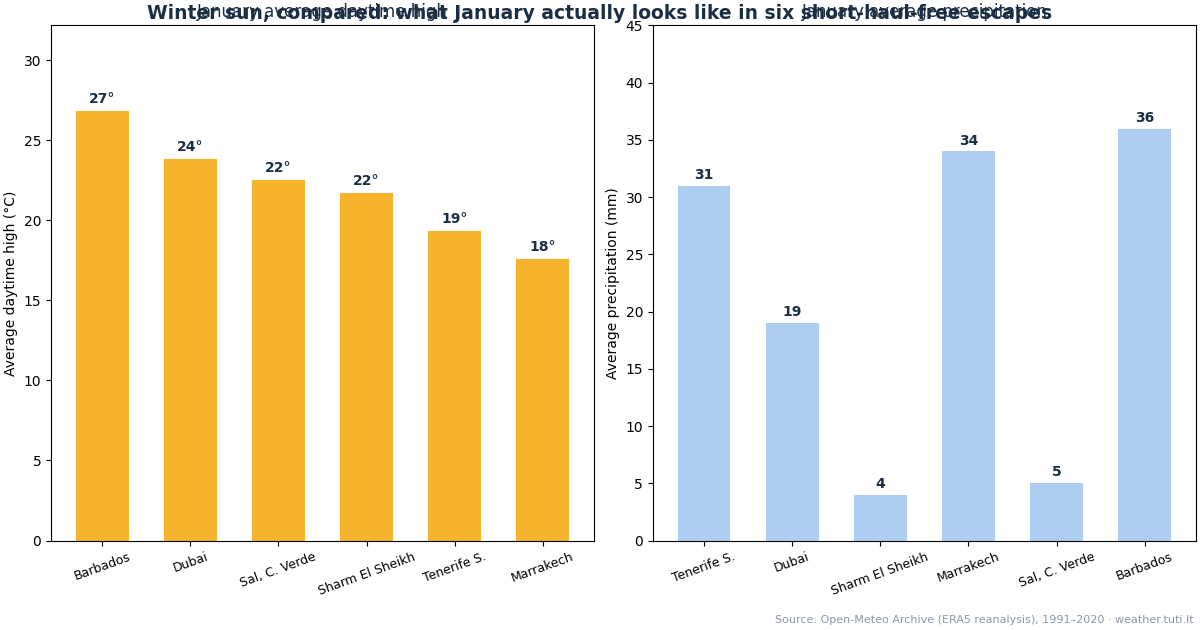
| Destination | Nov high | Dec high | Jan high | Feb high | Jan rain | Jan wet days |
|---|---|---|---|---|---|---|
| Tenerife (Canary Islands) | 22.4 °C | 20.4 °C | 19.3 °C | 19.5 °C | 31 mm | 18% |
| Dubai (UAE) | 30.4 °C | 26.0 °C | 23.8 °C | 25.4 °C | 19 mm | 9% |
| Sharm El Sheikh (Egypt) | 27.6 °C | 23.4 °C | 21.7 °C | 23.2 °C | 4 mm | 2% |
| Marrakech (Morocco) | 21.7 °C | 18.7 °C | 17.6 °C | 19.3 °C | 34 mm | 18% |
| Sal, Cape Verde | 25.4 °C | 23.8 °C | 22.5 °C | 22.0 °C | 5 mm | 2% |
| Bridgetown, Barbados | 27.7 °C | 27.3 °C | 26.8 °C | 26.9 °C | 36 mm | 34% |
What 'winter sun' actually means, month by month
Winter sun is a spectrum, not a switch. At the mild end sit the Canary Islands — genuinely warm, sometimes shirt-sleeve, occasionally showery. In the middle sit Egypt, Morocco and Dubai — reliably dry and warm by day, cold (or in Marrakech's case, cold) at night. At the tropical end sit Cape Verde and the Caribbean — properly hot, with rain profiles that differ in a way that matters (see the Atlantic hurricane season below).
The table above is the honest version of the brochures: four months of daytime highs, January's rain, and January's share of wet days. The sections below turn it into decisions.
Canary Islands: the near, mild option
Tenerife's south coast averages 19.3 °C by day in January — warm enough for a beach afternoon on a good day, and reliably bright enough for hiking Mount Teide's foothills, whale-watching and pool-side afternoons. Nights are mild (14.6 °C average low) rather than warm.
Rain is the trade: January averages 31 mm, falling on about 18% of days — usually as short frontal spells rather than washouts. The Canaries are the winter-sun choice for travellers who want Europe-adjacent logistics (four-hour flights, open restaurants year-round) more than tropical heat.
Dubai and Egypt: desert heat with a chill in the dark
Dubai runs the warmest desert winter of the short-haul-plus list: 23.8 °C January highs, 25.4 °C in February, and rain statistically negligible (19 mm). The desert evenings genuinely cool (14.4 °C average lows), which is a feature for desert safaris and a packing note for rooftop dinners.
Egypt's Red Sea coast is the sweet spot for heat-per-pound: Sharm El Sheikh averages 21.7 °C in January with 4 mm of rain, and the sea stays warm enough for the diving that made the region famous. Nights are mild, and the humidity far lower than the tropics — the classic 'guaranteed sun' winter formula.
Morocco: warm days, properly cold nights
Marrakech averages 17.6 °C by day in January — the same ball-park as Tenerife — but the desert-continent air drops nights near freezing (2.9 °C average low), and the year's rain falls in the cool half of the year (roughly 28–41 mm a month from November to April).
Read that as: glorious midday souks and riad rooftops, jackets by dinner. Marrakech is the winter pick for travellers who want culture-forward trips with sun rather than beach-afternoons-with-a-guarantee; the Atlas foothills can carry snow while the medina sits in sunshine.
Cape Verde and the Caribbean: proper heat, different rains
Sal in Cape Verde averages 22.5 °C by day in January with barely 5 mm of rain — Atlantic-tropical heat with a near-Sahel dry season, plus the steady trade winds that make it a windsurfing magnet. Nights stay around 21.0 °C: warm, not sweltering.
The Caribbean runs hottest — Bridgetown averages 26.8 °C in January with nights at 24.5 °C — but January–February sits inside the islands' drier half-year while the official Atlantic hurricane season runs June to November. Travellers book winter partly to sidestep that season; late-November trips should watch the live forecast until the season formally closes on 30 November.
So, which winter sun should you pick?
- Shortest flight, mildest trip: Canary Islands — warm days, some showers, everything open.
- Guaranteed dry heat: Egypt (Sharm, Hurghada) — the highest heat-per-rain-fallback ratio on the list.
- City-plus-sun: Dubai or Marrakech — with a jacket for the evenings either way.
- Proper tropical heat: Cape Verde (wind included) or the Caribbean (post-hurricane-season) — December to March is the core window.