Boston climate at a glance
The table below is the whole year compressed: the extremes and the averages that every month-by-month decision hangs on. All figures come from the Boston Logan International weather station (elevation 6 m), the closest high-quality record to the city.
| Metric | Annual value | Peak / extreme |
|---|---|---|
| Warmest month | December — 5.8 °C average daytime high | Record high at this station: 39.4 °C (2011) |
| Coldest month | January — -4.8 °C average overnight low | Record low at this station: -24.4 °C (1957) |
| Wettest month | December — 109 mm | About 1104 mm of precipitation across the whole year |
| Driest month | January — 86 mm | Best odds of dry sightseeing |
| Most daylight | 15.3 h / day at the summer peak | Shortest days: 9.1 h in the depth of winter |
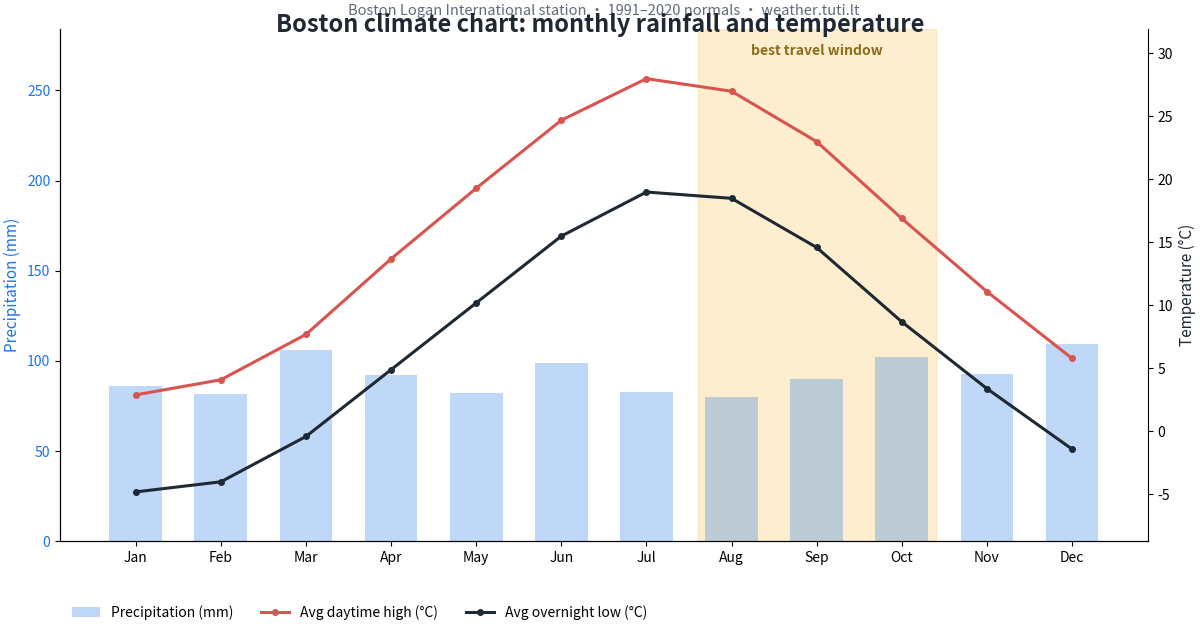
Boston weather by month
Read the table as follows: the daytime high is the mean of all daily maximums in that month across 1991–2020, the overnight low the mean of daily minimums, and a rainy day is any day with at least 1 mm of rain or melted snow. Daylight is astronomical (sunrise to sunset) at mid-month. Individual days will swing well beyond these averages — the live forecast is where the actual week ahead lives.
| Month | Avg high | Avg low | Rainy days (≥1 mm) | Rainfall | Daylight |
|---|---|---|---|---|---|
| January | 2.9 °C | -4.8 °C | 9 days | 86 mm | 9.4 h |
| February | 4.1 °C | -4 °C | 8 days | 82 mm | 10.5 h |
| March | 7.7 °C | -0.4 °C | 9 days | 106 mm | 11.9 h |
| April | 13.7 °C | 4.9 °C | 9 days | 92 mm | 13.3 h |
| May | 19.3 °C | 10.2 °C | 9 days | 82 mm | 14.6 h |
| June | 24.7 °C | 15.5 °C | 9 days | 99 mm | 15.3 h |
| July | 28 °C | 19 °C | 8 days | 83 mm | 15.0 h |
| August | 27 °C | 18.5 °C | 7 days | 80 mm | 14.0 h |
| September | 23 °C | 14.6 °C | 7 days | 90 mm | 12.6 h |
| October | 16.9 °C | 8.7 °C | 8 days | 102 mm | 11.1 h |
| November | 11.1 °C | 3.4 °C | 8 days | 93 mm | 9.8 h |
| December | 5.8 °C | -1.4 °C | 9 days | 109 mm | 9.1 h |
Season by season: what it feels like and what to pack
Spring (March–May) in Boston
Daytime highs average 13.6 °C, overnight lows 4.9 °C. Rainfall averages 94 mm a month, spread over about 9 wet days, and daylight runs 13.3 hours at the season's midpoint. Best suited to: city walking tours and gardens, when the humidity finally relents.
- What to pack (rule-based, from the numbers above):
- Pack a packable rain layer: about 9 days a month record measurable rain.
- Dress in layers you can shed — mild afternoons (14 °C) follow chilly mornings (5 °C).
Summer (June–August) in Boston
Daytime highs average 26.6 °C, overnight lows 17.7 °C. Rainfall averages 87 mm a month, spread over about 8 wet days, and daylight runs 14.8 hours at the season's midpoint. Best suited to: waterfront walks early in the day and air-conditioned museums at noon.
- What to pack (rule-based, from the numbers above):
- Standard all-season clothing works: layers, comfortable walking shoes and a light rain shell cover the range of conditions.
Autumn (September–November) in Boston
Daytime highs average 17 °C, overnight lows 8.9 °C. Rainfall averages 95 mm a month, spread over about 8 wet days, and daylight runs 11.2 hours at the season's midpoint. Best suited to: city walking tours and gardens, when the humidity finally relents.
- What to pack (rule-based, from the numbers above):
- Standard all-season clothing works: layers, comfortable walking shoes and a light rain shell cover the range of conditions.
Winter (December–February) in Boston
Daytime highs average 4.3 °C, overnight lows -3.4 °C. Rainfall averages 92 mm a month, spread over about 9 wet days, and daylight runs 9.7 hours at the season's midpoint. Best suited to: city walking tours and gardens, when the humidity finally relents.
- What to pack (rule-based, from the numbers above):
- Pack a packable rain layer: about 9 days a month record measurable rain.
- A warm mid-layer and waterproof outer shell; nights regularly touch freezing (-3 °C average low).
The local micro-climate: why Boston is not its map dot
Boston sits on the New England coast where warm Gulf Stream water meets frequent Canadian air masses — winters are stormy, snow-prone and cold, and the famous 'Nor'easter' cyclones can bury the city when cold air damming locks in east of the Appalachians. Spring is notoriously slow to warm because the nearby ocean stays near 5 °C into May.
Gardening note: the station record (1991–2020) puts the first autumn frost around 9 November and the last spring frost around 5 April — the frost-free window gardeners plan their season around.
Frequently asked questions about Boston weather
What is the rainiest month in Boston?
December is the wettest month on average, with about 109 mm of precipitation. For comparison, the driest month (January) averages 86 mm — the city collects roughly 1104 mm across the year.
Does it snow in Boston?
Yes, in winter: the station record shows an average of about 34 days per year with 1 cm or more of snow on the ground, most likely in January (10 days). Snow cover is intermittent rather than permanent.
How hot does Boston get in summer?
December is the warmest month, averaging daytime highs of 5.8 °C and overnight lows near -1.4 °C. The hottest day in this station's record reached 39.4 °C (2011).
How cold does Boston get in winter?
January is the coldest month (average overnight low -4.8 °C). The lowest temperature in this station's record is -24.4 °C (1957).
Compare Boston with nearby and similar climates
Context makes climate numbers meaningful. Compare Boston with New York, Montreal, Philadelphia, Toronto and Washington DC — each guide uses the same 30-year station methodology, so the differences you see are real differences, not different data sources.