Cancún climate at a glance
The table below is the whole year compressed: the extremes and the averages that every month-by-month decision hangs on. All figures come from the CANCUN, MX weather station (elevation 9 m), the closest high-quality record to the city.
| Metric | Annual value | Peak / extreme |
|---|---|---|
| Warmest month | December — 28.5 °C average daytime high | Record high at this station: 41.1 °C (2003) |
| Coldest month | January — 19.3 °C average overnight low | Record low at this station: 9.4 °C (1996) |
| Wettest month | December — 80 mm | About 1305 mm of precipitation across the whole year |
| Driest month | January — 107 mm | Best odds of dry sightseeing |
| Most daylight | 13.4 h / day at the summer peak | Shortest days: 10.9 h in the depth of winter |
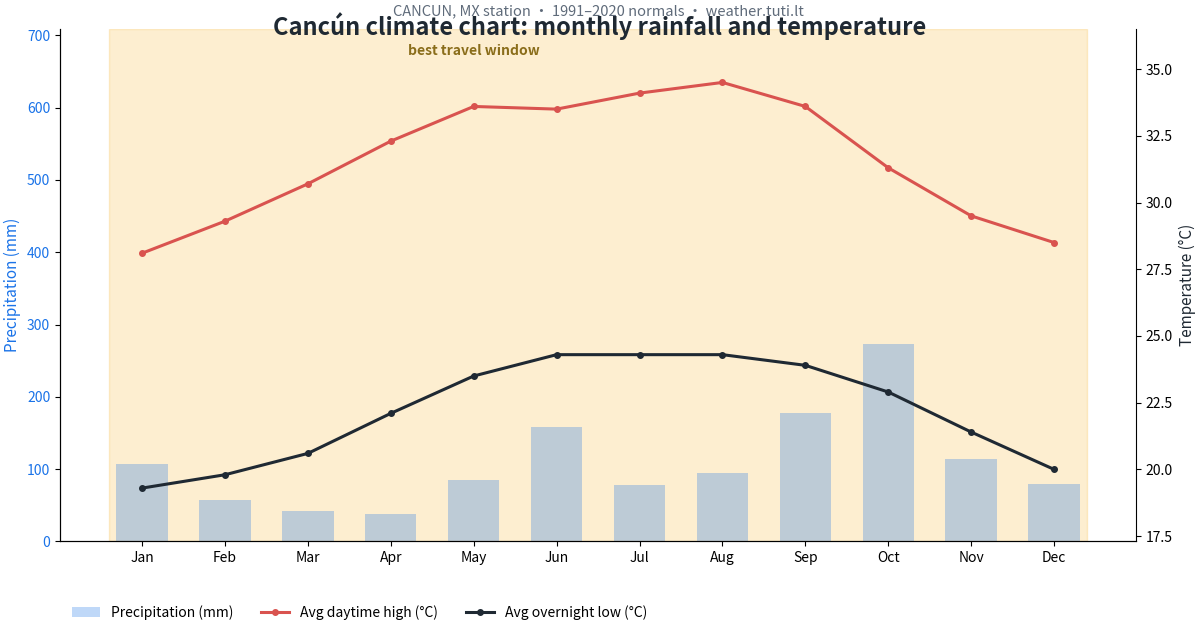
Cancún weather by month
Read the table as follows: the daytime high is the mean of all daily maximums in that month across 1991–2020, the overnight low the mean of daily minimums, and a rainy day is any day with at least 1 mm of rain or melted snow. Daylight is astronomical (sunrise to sunset) at mid-month. Individual days will swing well beyond these averages — the live forecast is where the actual week ahead lives.
| Month | Avg high | Avg low | Rainy days (≥1 mm) | Rainfall | Daylight |
|---|---|---|---|---|---|
| January | 28.1 °C | 19.3 °C | 7 days | 107 mm | 11.0 h |
| February | 29.3 °C | 19.8 °C | 4 days | 57 mm | 11.4 h |
| March | 30.7 °C | 20.6 °C | 4 days | 42 mm | 12.0 h |
| April | 32.3 °C | 22.1 °C | 3 days | 38 mm | 12.6 h |
| May | 33.6 °C | 23.5 °C | 5 days | 86 mm | 13.1 h |
| June | 33.5 °C | 24.3 °C | 9 days | 158 mm | 13.4 h |
| July | 34.1 °C | 24.3 °C | 7 days | 79 mm | 13.3 h |
| August | 34.5 °C | 24.3 °C | 8 days | 94 mm | 12.9 h |
| September | 33.6 °C | 23.9 °C | 11 days | 178 mm | 12.3 h |
| October | 31.3 °C | 22.9 °C | 13 days | 272 mm | 11.7 h |
| November | 29.5 °C | 21.4 °C | 8 days | 114 mm | 11.1 h |
| December | 28.5 °C | 20 °C | 7 days | 80 mm | 10.9 h |
Season by season: what it feels like and what to pack
Wet season in Cancún
Daytime highs average 30.4 °C, overnight lows 20.9 °C. Rainfall averages 68 mm a month across roughly 5 wet days in this half of the year, and daylight stays between 10.9 and 13.1 hours. The wet season here is less a wall of rain than a rhythm: bright mornings, a building afternoon thunderstorm, and clearing evenings — but flooding can disrupt low-lying districts on the heaviest days. Best suited to: beaches and water activities between the afternoon showers.
- What to pack (rule-based, from the numbers above):
- Light, breathable clothing and sunscreen — afternoons average 30 °C, and humidity makes it feel hotter.
Drier season in Cancún
Daytime highs average 32.8 °C, overnight lows 23.5 °C. Rainfall averages 149 mm a month across roughly 9 wet days in this half of the year, and daylight stays between 11.1 and 13.4 hours. The drier season brings the classic tropical postcard: more sun, lower humidity and the year's most reliable beach and boat weather. Best suited to: beaches and water activities between the afternoon showers.
- What to pack (rule-based, from the numbers above):
- Pack a packable rain layer: about 9 days a month record measurable rain.
- Light, breathable clothing and sunscreen — afternoons average 33 °C, and humidity makes it feel hotter.
The local micro-climate: why Cancún is not its map dot
Cancún sits on the Yucatán's northeast tip in the direct path of Caribbean systems: the June-to-November hurricane season overlaps the tropical wet season, while the November-to-April dry season delivers the region's postcard weather of warm days, trade winds and low rain. Sea temperatures stay swimmable year-round, peaking in September.
Frequently asked questions about Cancún weather
What is the rainiest month in Cancún?
December is the wettest month on average, with about 80 mm of precipitation. For comparison, the driest month (January) averages 107 mm — the city collects roughly 1305 mm across the year.
Does it snow in Cancún?
No — snowfall is not part of this city's climate. Winter precipitation (where it occurs at all) falls as rain, and temperatures do not reach the sustained freezing levels needed for snow to settle.
How hot does Cancún get in summer?
December is the warmest month, averaging daytime highs of 28.5 °C and overnight lows near 20 °C. The hottest day in this station's record reached 41.1 °C (2003).
How cold does Cancún get in winter?
January is the coldest month (average overnight low 19.3 °C). The lowest temperature in this station's record is 9.4 °C (1996).
Compare Cancún with nearby and similar climates
Context makes climate numbers meaningful. Compare Cancún with Havana and Miami — each guide uses the same 30-year station methodology, so the differences you see are real differences, not different data sources.