Nairobi climate at a glance
The table below is the whole year compressed: the extremes and the averages that every month-by-month decision hangs on. All figures come from the Nairobi (Wilson/Kenyatta aggregate) weather station (elevation 1624 m), the closest high-quality record to the city.
| Metric | Annual value | Peak / extreme |
|---|---|---|
| Warmest month | December — 25.7 °C average daytime high | Record high at this station: 38.2 °C (2006) |
| Coldest month | January — 13.9 °C average overnight low | Record low at this station: 0 °C (2008) |
| Wettest month | December — 86 mm | About 738 mm of precipitation across the whole year |
| Driest month | January — 61 mm | Best odds of dry sightseeing |
| Most daylight | 12.2 h / day at the summer peak | Shortest days: 12.0 h in the depth of winter |
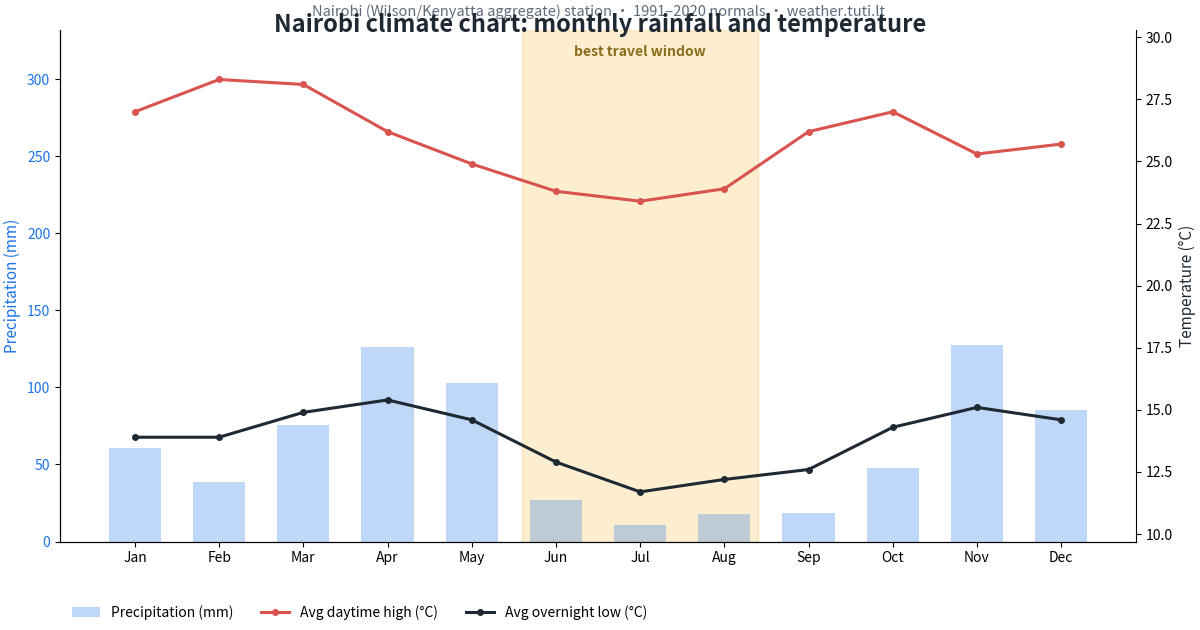
Nairobi weather by month
Read the table as follows: the daytime high is the mean of all daily maximums in that month across 1991–2020, the overnight low the mean of daily minimums, and a rainy day is any day with at least 1 mm of rain or melted snow. Daylight is astronomical (sunrise to sunset) at mid-month. Individual days will swing well beyond these averages — the live forecast is where the actual week ahead lives.
| Month | Avg high | Avg low | Rainfall | Daylight |
|---|---|---|---|---|
| January | 27 °C | 13.9 °C | 61 mm | 12.2 h |
| February | 28.3 °C | 13.9 °C | 38 mm | 12.2 h |
| March | 28.1 °C | 14.9 °C | 75 mm | 12.1 h |
| April | 26.2 °C | 15.4 °C | 126 mm | 12.1 h |
| May | 24.9 °C | 14.6 °C | 103 mm | 12.1 h |
| June | 23.8 °C | 12.9 °C | 27 mm | 12.0 h |
| July | 23.4 °C | 11.7 °C | 10 mm | 12.1 h |
| August | 23.9 °C | 12.2 °C | 18 mm | 12.1 h |
| September | 26.2 °C | 12.6 °C | 18 mm | 12.1 h |
| October | 27 °C | 14.3 °C | 48 mm | 12.1 h |
| November | 25.3 °C | 15.1 °C | 128 mm | 12.2 h |
| December | 25.7 °C | 14.6 °C | 86 mm | 12.2 h |
Season by season: what it feels like and what to pack
Wet season in Nairobi
Daytime highs average 26.7 °C, overnight lows 14.5 °C. Rainfall figures for these months are incomplete in the current station record. Altitude flattens the seasons: what changes through the year is the rain regime and the sun's angle, not the temperature. Best suited to: hiking and highland viewpoints in the clearest window of the year.
- What to pack (rule-based, from the numbers above):
- Standard all-season clothing works: layers, comfortable walking shoes and a light rain shell cover the range of conditions.
Drier season in Nairobi
Daytime highs average 24.9 °C, overnight lows 13.1 °C. Rainfall figures for these months are incomplete in the current station record. Altitude flattens the seasons: what changes through the year is the rain regime and the sun's angle, not the temperature. Best suited to: hiking and highland viewpoints in the clearest window of the year.
- What to pack (rule-based, from the numbers above):
- Standard all-season clothing works: layers, comfortable walking shoes and a light rain shell cover the range of conditions.
The local micro-climate: why Nairobi is not its map dot
Nairobi sits at 1,700 m on the equator, producing a highland climate of perpetual mild days (highs near 25 °C all year) and cool nights, with the year split by the two famous East African rains: the 'long rains' (March to May) and 'short rains' (October to December). Hail-bearing afternoon thunderstorms are a Nairobi institution, and the dry seasons bring the safari and stargazing weather.
Frequently asked questions about Nairobi weather
What is the rainiest month in Nairobi?
December is the wettest month on average, with about 86 mm of precipitation. For comparison, the driest month (January) averages 61 mm — the city collects roughly 738 mm across the year.
Does it snow in Nairobi?
Occasionally, but rarely enough to be news: the station record shows no consistent monthly snow cover. Cold snaps can bring brief snow or sleet, usually melting within a day.
How hot does Nairobi get in summer?
December is the warmest month, averaging daytime highs of 25.7 °C and overnight lows near 14.6 °C. The hottest day in this station's record reached 38.2 °C (2006).
How cold does Nairobi get in winter?
January is the coldest month (average overnight low 13.9 °C). The lowest temperature in this station's record is 0 °C (2008).
Compare Nairobi with nearby and similar climates
Context makes climate numbers meaningful. Compare Nairobi with Bogotá, Quito, Mexico City and Cape Town — each guide uses the same 30-year station methodology, so the differences you see are real differences, not different data sources.