Perth climate at a glance
The table below is the whole year compressed: the extremes and the averages that every month-by-month decision hangs on. All figures come from the Perth weather station (elevation 25 m), the closest high-quality record to the city.
| Metric | Annual value | Peak / extreme |
|---|---|---|
| Warmest month | December — 29.4 °C average daytime high | Record high at this station: 44.5 °C (1997) |
| Coldest month | January — 18.1 °C average overnight low | Record low at this station: -0.7 °C (2006) |
| Wettest month | December — 10 mm | About 724 mm of precipitation across the whole year |
| Driest month | January — 19 mm | Best odds of dry sightseeing |
| Most daylight | 14.2 h / day at the summer peak | Shortest days: 10.1 h in the depth of winter |
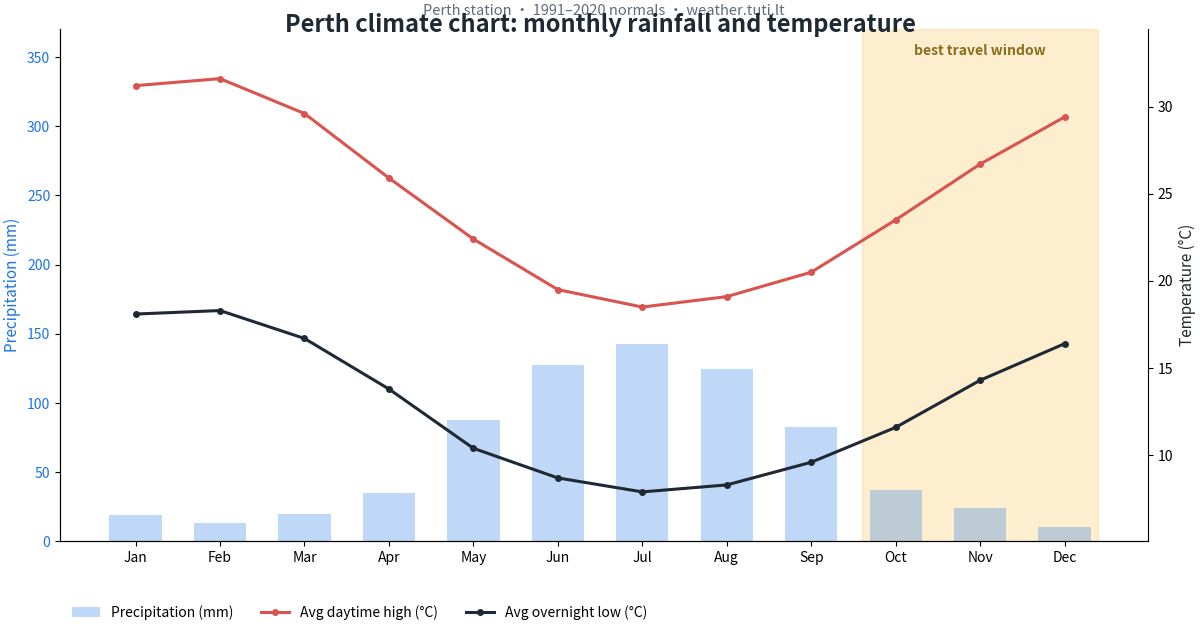
Perth weather by month
Read the table as follows: the daytime high is the mean of all daily maximums in that month across 1991–2020, the overnight low the mean of daily minimums, and a rainy day is any day with at least 1 mm of rain or melted snow. Daylight is astronomical (sunrise to sunset) at mid-month. Individual days will swing well beyond these averages — the live forecast is where the actual week ahead lives.
| Month | Avg high | Avg low | Rainy days (≥1 mm) | Rainfall | Daylight |
|---|---|---|---|---|---|
| January | 31.2 °C | 18.1 °C | 2 days | 19 mm | 14.0 h |
| February | 31.6 °C | 18.3 °C | 1 day | 13 mm | 13.2 h |
| March | 29.6 °C | 16.7 °C | 2 days | 20 mm | 12.3 h |
| April | 25.9 °C | 13.8 °C | 4 days | 35 mm | 11.3 h |
| May | 22.4 °C | 10.4 °C | 9 days | 88 mm | 10.5 h |
| June | 19.5 °C | 8.7 °C | 12 days | 127 mm | 10.1 h |
| July | 18.5 °C | 7.9 °C | 14 days | 142 mm | 10.2 h |
| August | 19.1 °C | 8.3 °C | 13 days | 124 mm | 10.9 h |
| September | 20.5 °C | 9.6 °C | 11 days | 83 mm | 11.9 h |
| October | 23.5 °C | 11.6 °C | 6 days | 37 mm | 12.8 h |
| November | 26.7 °C | 14.3 °C | 4 days | 24 mm | 13.7 h |
| December | 29.4 °C | 16.4 °C | 2 days | 10 mm | 14.2 h |
Season by season: what it feels like and what to pack
Summer (December–February) in Perth
Daytime highs average 30.7 °C, overnight lows 17.6 °C. Rainfall averages 14 mm a month, spread over about 2 wet days, and daylight runs 13.8 hours at the season's midpoint. Rain becomes a statistical curiosity: weeks can pass without a drop, and the main weather risk is UV and heat rather than storms. Best suited to: beaches and coastal paths, with sightseeing early or late in the day.
- What to pack (rule-based, from the numbers above):
- Light, breathable clothing and sunscreen — afternoons average 31 °C, and humidity makes it feel hotter.
Autumn (March–May) in Perth
Daytime highs average 26 °C, overnight lows 13.6 °C. Rainfall averages 48 mm a month, spread over about 5 wet days, and daylight runs 11.4 hours at the season's midpoint. This is when the Mediterranean's rainy season actually happens — frontal systems return off the sea, and the heaviest downpours of the year typically land in these months. Best suited to: beaches and coastal paths, with sightseeing early or late in the day.
- What to pack (rule-based, from the numbers above):
- Standard all-season clothing works: layers, comfortable walking shoes and a light rain shell cover the range of conditions.
Winter (June–August) in Perth
Daytime highs average 19 °C, overnight lows 8.3 °C. Rainfall averages 131 mm a month, spread over about 13 wet days, and daylight runs 10.4 hours at the season's midpoint. This is when the Mediterranean's rainy season actually happens — frontal systems return off the sea, and the heaviest downpours of the year typically land in these months. Best suited to: sightseeing and hiking — crowds are gone and the light is superb.
- What to pack (rule-based, from the numbers above):
- A waterproof shell jacket and water-resistant footwear are essential — roughly 13 days a month here see at least 1 mm of rain.
Spring (September–November) in Perth
Daytime highs average 23.6 °C, overnight lows 11.8 °C. Rainfall averages 48 mm a month, spread over about 7 wet days, and daylight runs 12.8 hours at the season's midpoint. This is when the Mediterranean's rainy season actually happens — frontal systems return off the sea, and the heaviest downpours of the year typically land in these months. Best suited to: sightseeing and hiking — crowds are gone and the light is superb.
- What to pack (rule-based, from the numbers above):
- Standard all-season clothing works: layers, comfortable walking shoes and a light rain shell cover the range of conditions.
The local micro-climate: why Perth is not its map dot
Perth is one of the sunniest capitals on Earth, with a Mediterranean rhythm: hot, extraordinarily dry summers and a short, stormy winter rainy season as fronts clip the southwest corner of Australia. The Fremantle Doctor sea breeze reliably cools summer afternoons, and heat arriving from the interior can hold temperatures above 35 °C for days when it fails to arrive.
Frequently asked questions about Perth weather
What is the rainiest month in Perth?
December is the wettest month on average, with about 10 mm of precipitation. For comparison, the driest month (January) averages 19 mm — the city collects roughly 724 mm across the year.
Does it snow in Perth?
Occasionally, but rarely enough to be news: the station record shows no consistent monthly snow cover. Cold snaps can bring brief snow or sleet, usually melting within a day.
How hot does Perth get in summer?
December is the warmest month, averaging daytime highs of 29.4 °C and overnight lows near 16.4 °C. The hottest day in this station's record reached 44.5 °C (1997).
How cold does Perth get in winter?
January is the coldest month (average overnight low 18.1 °C). The lowest temperature in this station's record is -0.7 °C (2006).
Compare Perth with nearby and similar climates
Context makes climate numbers meaningful. Compare Perth with Melbourne, Sydney and Cape Town — each guide uses the same 30-year station methodology, so the differences you see are real differences, not different data sources.