Phoenix climate at a glance
The table below is the whole year compressed: the extremes and the averages that every month-by-month decision hangs on. All figures come from the Phoenix Sky Harbor Airport weather station (elevation 345 m), the closest high-quality record to the city.
| Metric | Annual value | Peak / extreme |
|---|---|---|
| Warmest month | December — 19.1 °C average daytime high | Record high at this station: 50 °C (1990) |
| Coldest month | January — 7.7 °C average overnight low | Record low at this station: -8.3 °C (1950) |
| Wettest month | December — 19 mm | About 184 mm of precipitation across the whole year |
| Driest month | January — 22 mm | One of the driest cities on Earth |
| Most daylight | 14.4 h / day at the summer peak | Shortest days: 10.0 h in the depth of winter |
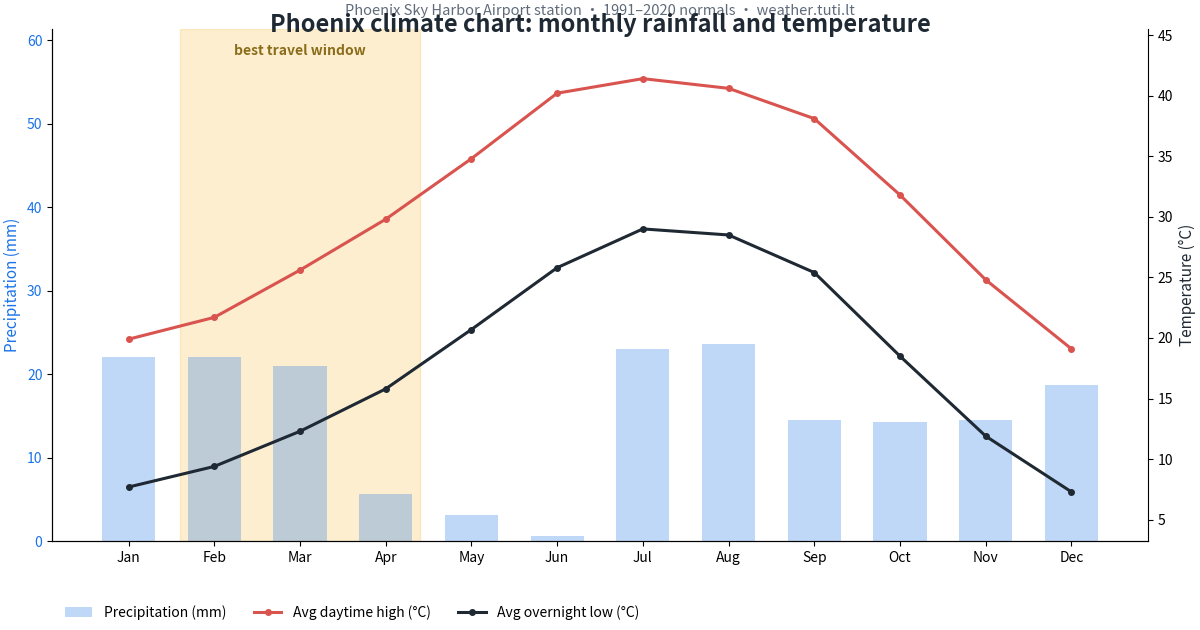
Phoenix weather by month
Read the table as follows: the daytime high is the mean of all daily maximums in that month across 1991–2020, the overnight low the mean of daily minimums, and a rainy day is any day with at least 1 mm of rain or melted snow. Daylight is astronomical (sunrise to sunset) at mid-month. Individual days will swing well beyond these averages — the live forecast is where the actual week ahead lives.
| Month | Avg high | Avg low | Rainy days (≥1 mm) | Rainfall | Daylight |
|---|---|---|---|---|---|
| January | 19.9 °C | 7.7 °C | 3 days | 22 mm | 10.2 h |
| February | 21.7 °C | 9.4 °C | 3 days | 22 mm | 11.0 h |
| March | 25.6 °C | 12.3 °C | 2 days | 21 mm | 11.9 h |
| April | 29.8 °C | 15.8 °C | 1 day | 6 mm | 13.0 h |
| May | 34.8 °C | 20.7 °C | 1 day | 3 mm | 13.9 h |
| June | 40.2 °C | 25.8 °C | 0 days | 1 mm | 14.4 h |
| July | 41.4 °C | 29 °C | 3 days | 23 mm | 14.2 h |
| August | 40.6 °C | 28.5 °C | 3 days | 24 mm | 13.4 h |
| September | 38.1 °C | 25.4 °C | 2 days | 15 mm | 12.4 h |
| October | 31.8 °C | 18.5 °C | 2 days | 14 mm | 11.4 h |
| November | 24.8 °C | 11.9 °C | 2 days | 15 mm | 10.5 h |
| December | 19.1 °C | 7.3 °C | 3 days | 19 mm | 10.0 h |
Season by season: what it feels like and what to pack
Spring (March–May) in Phoenix
Daytime highs average 30.1 °C, overnight lows 16.3 °C. Rainfall averages 10 mm a month, spread over about 1 wet day, and daylight runs 12.9 hours at the season's midpoint. Best suited to: early-morning desert excursions, malls and pools until the evening cool.
- What to pack (rule-based, from the numbers above):
- Light, breathable clothing and sunscreen — afternoons average 30 °C, and humidity makes it feel hotter.
- In the dry heat, cover up rather than strip down: a light long-sleeve layer, hat and sunglasses beat bare skin in this sun.
Summer (June–August) in Phoenix
Daytime highs average 40.7 °C, overnight lows 27.8 °C. Rainfall averages 16 mm a month, spread over about 2 wet days, and daylight runs 14.0 hours at the season's midpoint. There is no polite way to say it: this is the season to endure rather than enjoy, with heat that genuinely limits outdoor activity between late morning and late afternoon. Best suited to: early-morning desert excursions, malls and pools until the evening cool.
- What to pack (rule-based, from the numbers above):
- Plan around the heat: loose light clothing, a refillable water bottle, and schedule outdoor time before 11:00 or after 16:00.
- In the dry heat, cover up rather than strip down: a light long-sleeve layer, hat and sunglasses beat bare skin in this sun.
Autumn (September–November) in Phoenix
Daytime highs average 31.6 °C, overnight lows 18.6 °C. Rainfall averages 14 mm a month, spread over about 2 wet days, and daylight runs 11.4 hours at the season's midpoint. Best suited to: early-morning desert excursions, malls and pools until the evening cool.
- What to pack (rule-based, from the numbers above):
- Light, breathable clothing and sunscreen — afternoons average 32 °C, and humidity makes it feel hotter.
- In the dry heat, cover up rather than strip down: a light long-sleeve layer, hat and sunglasses beat bare skin in this sun.
Winter (December–February) in Phoenix
Daytime highs average 20.2 °C, overnight lows 8.1 °C. Rainfall averages 21 mm a month, spread over about 3 wet days, and daylight runs 10.4 hours at the season's midpoint. Winter is when the desert becomes liveable — warm sun by day, pleasantly cool nights, and the occasional rain front that briefly greens the margins of the city. Best suited to: dune trips, desert camping and city sightseeing — this is prime season.
- What to pack (rule-based, from the numbers above):
- Standard all-season clothing works: layers, comfortable walking shoes and a light rain shell cover the range of conditions.
The local micro-climate: why Phoenix is not its map dot
Phoenix is the hottest major city in the United States: summer highs average above 41 °C and the urban heat island keeps nights above 32 °C for weeks, while the North American monsoon (July to September) adds dramatic thunderstorms and dust walls called haboobs. Winter is the glorious season — sunny, dry, and mild enough for golf.
Frequently asked questions about Phoenix weather
What is the rainiest month in Phoenix?
December is the wettest month on average, with about 19 mm of precipitation. For comparison, the driest month (January) averages 22 mm — the city collects roughly 184 mm across the year.
Does it snow in Phoenix?
No — snowfall is not part of this city's climate. Winter precipitation (where it occurs at all) falls as rain, and temperatures do not reach the sustained freezing levels needed for snow to settle.
How hot does Phoenix get in summer?
December is the warmest month, averaging daytime highs of 19.1 °C and overnight lows near 7.3 °C. The hottest day in this station's record reached 50 °C (1990).
How cold does Phoenix get in winter?
January is the coldest month (average overnight low 7.7 °C). The lowest temperature in this station's record is -8.3 °C (1950).
Compare Phoenix with nearby and similar climates
Context makes climate numbers meaningful. Compare Phoenix with Las Vegas, Tucson, Los Angeles, Denver and Dubai — each guide uses the same 30-year station methodology, so the differences you see are real differences, not different data sources.