Tel Aviv climate at a glance
The table below is the whole year compressed: the extremes and the averages that every month-by-month decision hangs on. All figures come from the Bet Dagan weather station (elevation 30 m), the closest high-quality record to the city.
| Metric | Annual value | Peak / extreme |
|---|---|---|
| Warmest month | December — 20.3 °C average daytime high | Record high at this station: 45.6 °C (1970) |
| Coldest month | January — 7.9 °C average overnight low | Record low at this station: -2.2 °C (1972) |
| Wettest month | December — 115 mm | About 492 mm of precipitation across the whole year |
| Driest month | January — 134 mm | Best odds of dry sightseeing |
| Most daylight | 14.2 h / day at the summer peak | Shortest days: 10.1 h in the depth of winter |
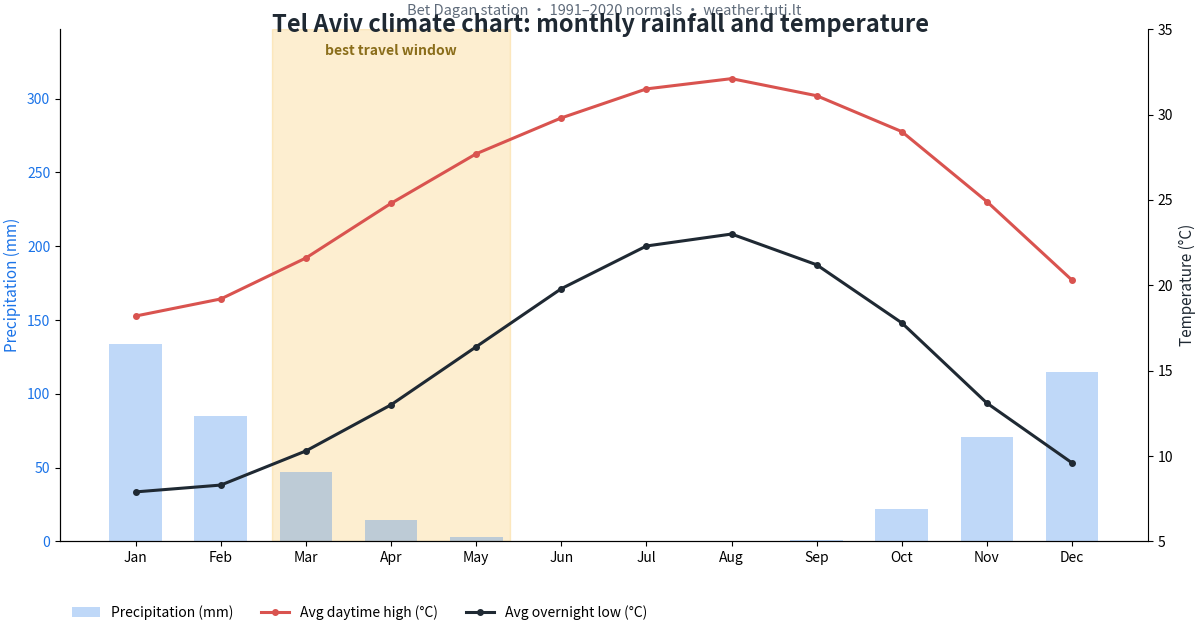
Tel Aviv weather by month
Read the table as follows: the daytime high is the mean of all daily maximums in that month across 1991–2020, the overnight low the mean of daily minimums, and a rainy day is any day with at least 1 mm of rain or melted snow. Daylight is astronomical (sunrise to sunset) at mid-month. Individual days will swing well beyond these averages — the live forecast is where the actual week ahead lives.
| Month | Avg high | Avg low | Rainy days (≥1 mm) | Rainfall | Daylight |
|---|---|---|---|---|---|
| January | 18.2 °C | 7.9 °C | 10 days | 134 mm | 10.3 h |
| February | 19.2 °C | 8.3 °C | 8 days | 85 mm | 11.0 h |
| March | 21.6 °C | 10.3 °C | 5 days | 47 mm | 11.9 h |
| April | 24.8 °C | 13 °C | 2 days | 15 mm | 12.9 h |
| May | 27.7 °C | 16.4 °C | 1 day | 3 mm | 13.8 h |
| June | 29.8 °C | 19.8 °C | 0 days | 1 mm | 14.2 h |
| July | 31.5 °C | 22.3 °C | 0 days | 0 mm | 14.1 h |
| August | 32.1 °C | 23 °C | 0 days | 0 mm | 13.4 h |
| September | 31.1 °C | 21.2 °C | 0 days | 1 mm | 12.4 h |
| October | 29 °C | 17.8 °C | 2 days | 22 mm | 11.4 h |
| November | 24.9 °C | 13.1 °C | 5 days | 71 mm | 10.5 h |
| December | 20.3 °C | 9.6 °C | 8 days | 115 mm | 10.1 h |
Season by season: what it feels like and what to pack
Spring (March–May) in Tel Aviv
Daytime highs average 24.7 °C, overnight lows 13.2 °C. Rainfall averages 22 mm a month, spread over about 2 wet days, and daylight runs 12.9 hours at the season's midpoint. This is when the Mediterranean's rainy season actually happens — frontal systems return off the sea, and the heaviest downpours of the year typically land in these months. Best suited to: beaches and coastal paths, with sightseeing early or late in the day.
- What to pack (rule-based, from the numbers above):
- Standard all-season clothing works: layers, comfortable walking shoes and a light rain shell cover the range of conditions.
Summer (June–August) in Tel Aviv
Daytime highs average 31.1 °C, overnight lows 21.7 °C. Rainfall averages 0 mm a month, spread over about 0 wet days, and daylight runs 13.9 hours at the season's midpoint. Rain becomes a statistical curiosity: weeks can pass without a drop, and the main weather risk is UV and heat rather than storms. Best suited to: beaches and coastal paths, with sightseeing early or late in the day.
- What to pack (rule-based, from the numbers above):
- Rain gear is almost pointless — a month here sees on average under one wet day.
- Light, breathable clothing and sunscreen — afternoons average 31 °C, and humidity makes it feel hotter.
Autumn (September–November) in Tel Aviv
Daytime highs average 28.3 °C, overnight lows 17.4 °C. Rainfall averages 31 mm a month, spread over about 2 wet days, and daylight runs 11.4 hours at the season's midpoint. This is when the Mediterranean's rainy season actually happens — frontal systems return off the sea, and the heaviest downpours of the year typically land in these months. Best suited to: beaches and coastal paths, with sightseeing early or late in the day.
- What to pack (rule-based, from the numbers above):
- Light, breathable clothing and sunscreen — afternoons average 28 °C, and humidity makes it feel hotter.
Winter (December–February) in Tel Aviv
Daytime highs average 19.2 °C, overnight lows 8.6 °C. Rainfall averages 111 mm a month, spread over about 8 wet days, and daylight runs 10.5 hours at the season's midpoint. This is when the Mediterranean's rainy season actually happens — frontal systems return off the sea, and the heaviest downpours of the year typically land in these months. Best suited to: sightseeing and hiking — crowds are gone and the light is superb.
- What to pack (rule-based, from the numbers above):
- Pack a packable rain layer: about 8 days a month record measurable rain.
The local micro-climate: why Tel Aviv is not its map dot
Tel Aviv faces the eastern Mediterranean directly, so sea breezes temper a very hot, dry summer regime; humidity stays high even when rain is absent for months. The rainy season is short (November to March), and the desert's edge is near: hot, dusty Khamsin-type easterlies from the Negev and Sinai can push spring temperatures above 35 °C within hours.
Frequently asked questions about Tel Aviv weather
What is the rainiest month in Tel Aviv?
December is the wettest month on average, with about 115 mm of precipitation. For comparison, the driest month (January) averages 134 mm — the city collects roughly 492 mm across the year.
Does it snow in Tel Aviv?
Occasionally, but rarely enough to be news: the station record shows no consistent monthly snow cover. Cold snaps can bring brief snow or sleet, usually melting within a day.
How hot does Tel Aviv get in summer?
December is the warmest month, averaging daytime highs of 20.3 °C and overnight lows near 9.6 °C. The hottest day in this station's record reached 45.6 °C (1970).
How cold does Tel Aviv get in winter?
January is the coldest month (average overnight low 7.9 °C). The lowest temperature in this station's record is -2.2 °C (1972).
Compare Tel Aviv with nearby and similar climates
Context makes climate numbers meaningful. Compare Tel Aviv with Athens, Cairo and Rome — each guide uses the same 30-year station methodology, so the differences you see are real differences, not different data sources.