Read the table as follows: the daytime high is the average of all daily maximums for that month across 1991–2020, the overnight low the average of all daily minimums, and the wet-day share is the fraction of days collecting at least 1 mm. For the actual week ahead, the live Kotor forecast is the tool.
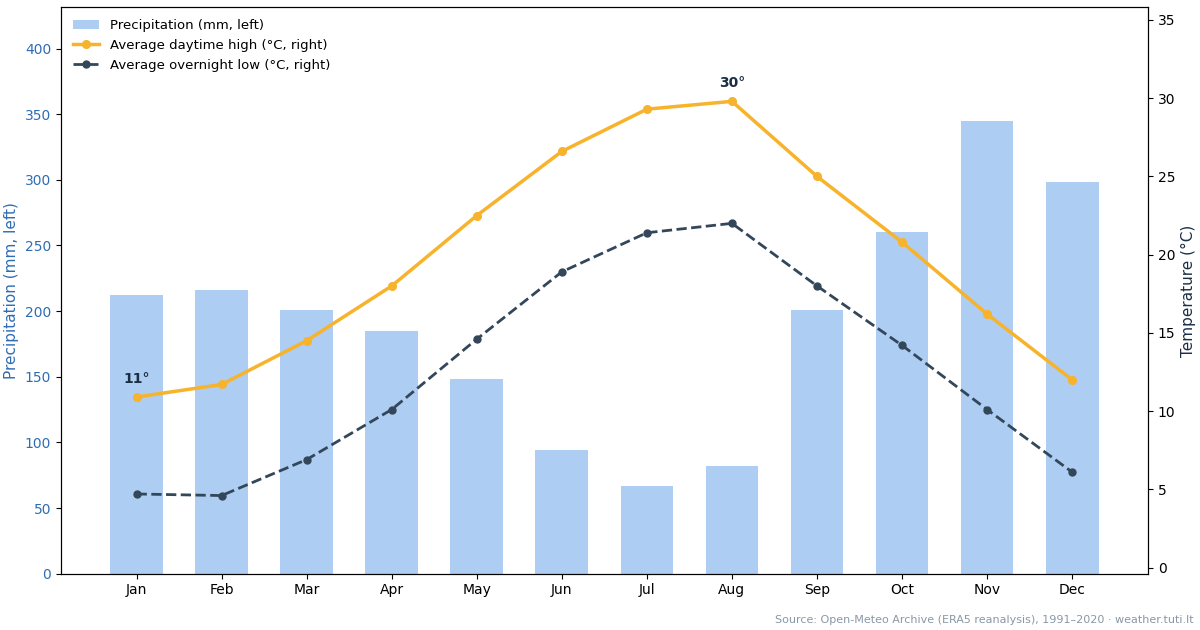
| Month | Avg. daytime high | Avg. overnight low | Avg. precipitation | Days with ≥1 mm | Daylight |
|---|---|---|---|---|---|
| January | 10.9 °C | 4.7 °C | 212 mm | 39% | 9.5 h |
| February | 11.7 °C | 4.6 °C | 216 mm | 43% | 10.6 h |
| March | 14.5 °C | 6.9 °C | 201 mm | 40% | 11.9 h |
| April | 18.0 °C | 10.1 °C | 185 mm | 48% | 13.4 h |
| May | 22.5 °C | 14.6 °C | 148 mm | 45% | 14.6 h |
| June | 26.6 °C | 18.9 °C | 94 mm | 38% | 15.2 h |
| July | 29.3 °C | 21.4 °C | 67 mm | 31% | 14.9 h |
| August | 29.8 °C | 22.0 °C | 82 mm | 31% | 13.9 h |
| September | 25.0 °C | 18.0 °C | 201 mm | 35% | 12.5 h |
| October | 20.8 °C | 14.2 °C | 260 mm | 39% | 11.1 h |
| November | 16.2 °C | 10.1 °C | 345 mm | 46% | 9.8 h |
| December | 12.0 °C | 6.1 °C | 298 mm | 44% | 9.1 h |
A fjord-shaped microclimate
The Bay of Kotor is a drowned river valley walled in by limestone mountains, and the geometry does three things to the weather: it traps humidity, it shades the waterline for part of the day, and it wrings extra rain out of the autumn and winter systems that roll in from the Adriatic. Kotor's annual total is far higher than the Dalmatian islands' — compare it with Dubrovnik's numbers and the difference is obvious.
The same walls make the heat feel heavier in summer: on a still July afternoon the old town holds the day's warmth into the evening. The reward for the geometry is drama — cloud piling onto the black mountains, sudden clearings, and waterfalls appearing on the cliffs after rain.
May and June: the walls before the heat
May brings average highs of 22.5 °C and daylight stretching to 14.6 hours; June warms to 26.6 °C with rain still moderate (94 mm). The climb to the Castle of San Giovanni (the fortress on the walls above the town) is a morning-before-the-heat outing, and the sea at the tiny swimming spots along the bay is warming through.
June is also the month the bay's small beaches and ferry crossings run at full rhythm without the crush — Perast and Our Lady of the Rocks are a short, calm boat ride away.
July and August: hot, busy, still beautiful
July averages a daytime high of 29.3 °C and August 29.8 °C, with overnight lows that barely fall below 21.4 °C in July. Rain is minimal (67 mm and 82 mm), the Adriatic is at its warmest, and the cruise-ship calendar is at its peak — check the port schedule if empty lanes matter to you.
The workable summer pattern is coastal-Mediterranean-standard: fortress climb or Old Wall walk before breakfast, beach or boat in the middle of the day, town after sunset when the walls light up. The evening café scene is genuinely the best part of a hot-weather Kotor.
September and October: the locals' favourite
September keeps summer's warmth (25.0 °C average high) while the crowds thin; October cools to 20.8 °C and the first autumn rains arrive (260 mm). The sea is still warm from the summer — swimming into October is entirely plausible in warm years.
For walkers these two months are the best of the year: the serpentine old mule trail up to the fortress, the ridgeline above Perast and the coastal path to Budva are all far kinder at 22 °C than at 32 °C.
November to April: moody, mild and cheap
November is the wettest month of Kotor's year (345 mm) and December follows with 298 mm; from January the totals ease off (212 mm) while highs hold around 10.9 °C–11.7 °C. Winter days are often grey rather than cold, and when the bura — a dry, gusty north-easterly funnelling down the mountains — blows, it clears the air and cuts the temperature in one move.
It is a good season for a slow, cheap stay: the old town without queues, locals' cafés, day trips to Budva, Cetinje or Perast. Just carry rain gear, and treat the hourly forecast as the plan-maker it is.
So, when should you go?
- First visit, town-and-bay trip: May–June or September–October — warm, swimmable, calmer streets.
- Hiker: late April–May or October — the fortress and ridge walks at their kindest.
- Sea-first traveller: July–August, with morning activities and evening old-town hours.
- Slow-travel winter stay: November–February — mild days, low prices, moody bay scenery.