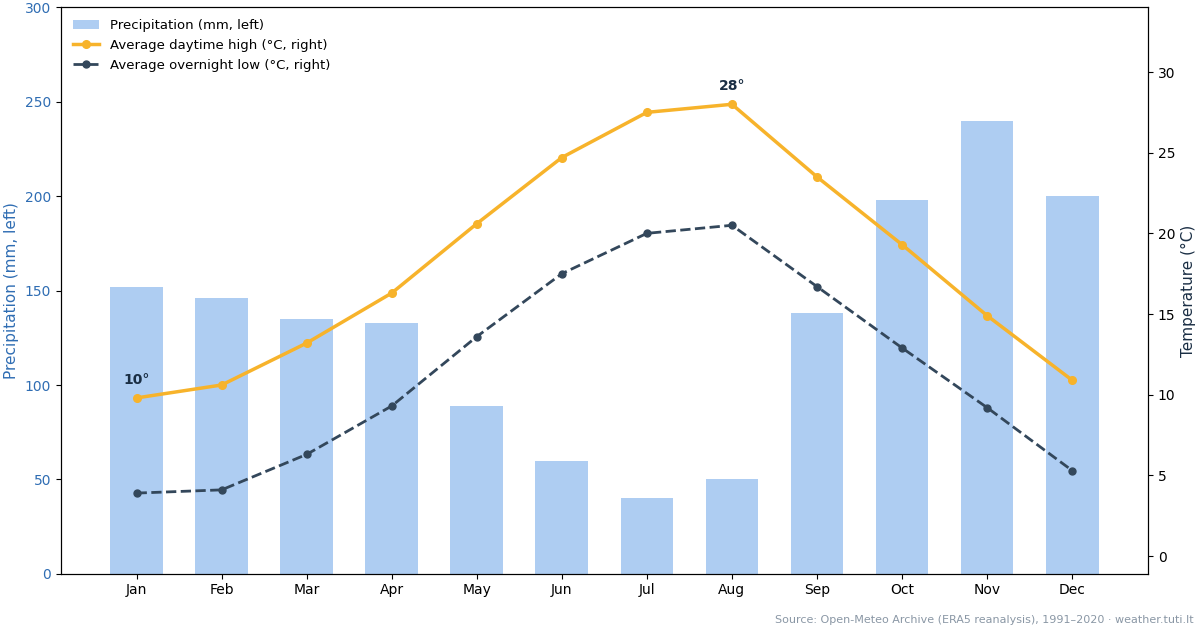
Read the table as follows: the daytime high is the average of all daily maximums for that month across 1991–2020, the overnight low the average of all daily minimums, and the wet-day share the fraction of days with at least 1 mm. For the week ahead, use the live Dubrovnik forecast.
| Month | Avg. daytime high | Avg. overnight low | Avg. precipitation | Days with ≥1 mm | Daylight |
|---|---|---|---|---|---|
| January | 9.8 °C | 3.9 °C | 152 mm | 36% | 9.5 h |
| February | 10.6 °C | 4.1 °C | 146 mm | 39% | 10.6 h |
| March | 13.2 °C | 6.3 °C | 135 mm | 36% | 11.9 h |
| April | 16.3 °C | 9.3 °C | 133 mm | 42% | 13.4 h |
| May | 20.6 °C | 13.6 °C | 89 mm | 32% | 14.6 h |
| June | 24.7 °C | 17.5 °C | 60 mm | 24% | 15.3 h |
| July | 27.5 °C | 20.0 °C | 40 mm | 18% | 14.9 h |
| August | 28.0 °C | 20.5 °C | 50 mm | 17% | 13.9 h |
| September | 23.5 °C | 16.7 °C | 138 mm | 29% | 12.5 h |
| October | 19.3 °C | 12.9 °C | 198 mm | 36% | 11.0 h |
| November | 14.9 °C | 9.2 °C | 240 mm | 46% | 9.8 h |
| December | 10.9 °C | 5.3 °C | 200 mm | 42% | 9.1 h |
A limestone amphitheatre over the Adriatic
Dubrovnik's old town sits in a stone bowl facing the sea, backed by Mount Srđ — which means the summer sun reflects off both walls and paving, and the evening breeze off the Adriatic is the town's air conditioning. The Dalmatian coast is drier than the Kotor bay next door; compare the monthly rain bars with Kotor's chart and the mountain-wrung difference is obvious.
Winter brings the bora — a dry, gusty north-easterly that can suddenly flatten the ferries — and the autumn rains the postcards never mention.
May and June: the walls at their best
May opens the season with an average high of 20.6 °C and daylight running to 14.6 hours; June warms to 24.7 °C with barely 60 mm of rain. The circuit of the city walls, the cable car to Srđ and the Lokrum ferry are all running, and the cruise calendar has not yet hit its peak.
Swimming becomes genuinely pleasant in June; the water is still brisk but the air is warm enough that a dip is a relief rather than an event.
July and August: high season on hot stone
July averages 27.5 °C and August 28.0 °C, with overnight lows near 20.0 °C and rain almost absent (40 mm and 50 mm). The walls, the Stradun and the beaches run at maximum capacity — the cruise ships disgorge thousands mid-morning, which defines the town's daily rhythm.
The strategy is timing: walls at opening, beaches and boat days midday, Stradun and the fortresses in the evening when the stone cools. August's sea — warm from a month of sun — makes the beach half of that equation easy.
September and October: warm sea, emptying walls
September is the month regulars choose: 23.5 °C average highs, a warm sea, and the queues thinning. October cools to 19.3 °C as the first autumn fronts arrive (198 mm), but bright, still days between them are common and the light on the limestone is the year's best.
November to April: storms, bora and bargains
November (240 mm) and December (200 mm) are the wettest months — the Adriatic's storm season, when southern-exposure fronts can deliver days of rain in a row. January and February are chillier but drier (9.8 °C and 10.6 °C average highs), with frost rare at the waterline.
It is a quiet, cheap, atmospheric season: Christmas decorations on a near-empty Stradun, locals' cafés, and days you can plan around the hourly forecast. Just note some seasonal restaurants close and sea ferries shrink.
So, when should you go?
- First visit, walls-and-islands trip: late May–June or September — open season, warm sea, bearable crowds.
- Must-do summer: July–August with morning walls, afternoon beach, evening town.
- Photographer: October — low light, moody fronts, quiet lanes.
- Budget or slow traveller: November–March, with the slow-travel case made properly.