One number per trend, so the argument is visible at a glance — every figure computed from 1991–2020 reanalysis data:
| Trend | Flagship destination | Signature number |
|---|---|---|
| “Coolcations” | Reykjavík, Iceland | July average high 14.5 °C — vs 27.4 °C in Barcelona |
| Slow travel | Kotor, Montenegro | October average high 20.8 °C, rain 260 mm — the shoulder sweet spot |
| Solo & wellness | Bangkok → islands, Thailand | December average high 30.7 °C, rain 10 mm — the cool-season window |
| Domestic staycation | St Ives, Cornwall | August average high 18.9 °C, rain 70 mm |
Coolcations: shopping for a summer temperature
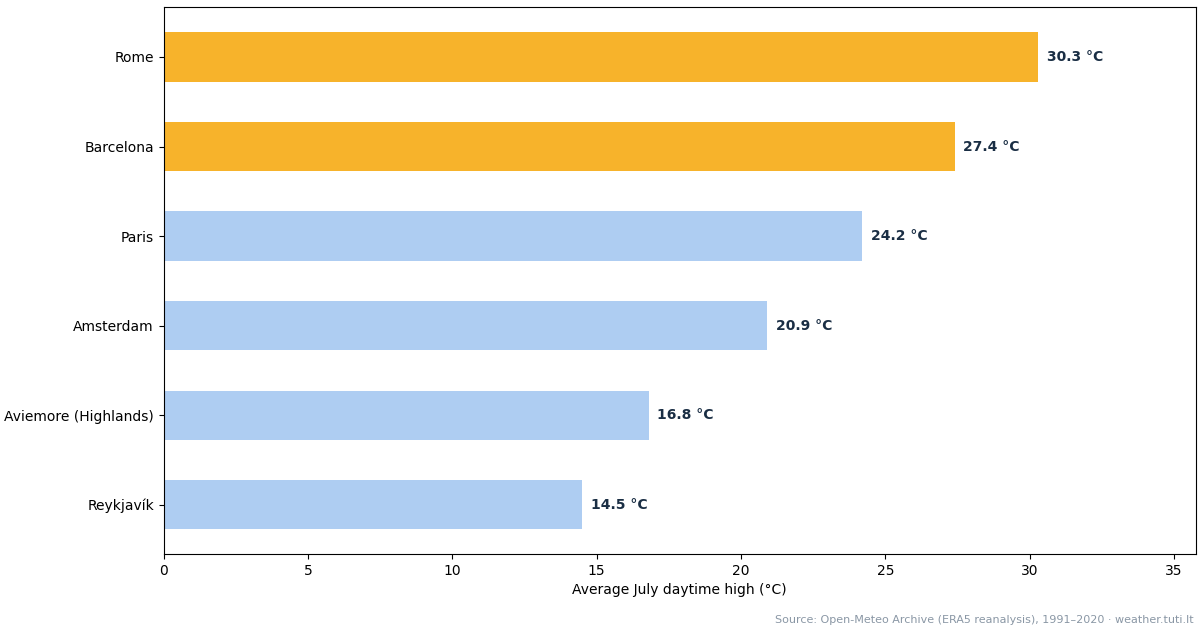
The headline trend of the last few summers — travellers steering away from Mediterranean heatwaves toward Iceland, the Scottish Highlands and Nordic cities — is really a market responding to the chart above: between Barcelona and Reykjavík lies a whole ladder of July temperatures, and most of the ladder's lower rungs are within a two-hour flight of the UK.
The data makes the case concrete: Barcelona averages 27.4 °C in July, Paris 24.2 °C, Amsterdam 20.9 °C, the Cairngorms town of Aviemore 16.8 °C and Reykjavík 14.5 °C. For heat-sensitive travellers the Highlands and Iceland are not merely 'cooler', they are 15–20 degrees cooler — the difference between a walking day and a siesta day.
The practical coolcation notes: Scotland's summer rain is real (Aviemore collects about 88 mm in July), Reykjavík's wind is the real forecast variable, and the June–August window is when both destinations run their full services. Start with the Reykjavík guide for the Arctic version.
Slow travel: the shoulder-season pattern, repeated
The trend for longer stays in a single village or coastal town — multi-week rentals, one base, day trips by foot and ferry — reads from the climate data as a shoulder-season preference, and for a clear reason: the shoulder months combine the year's calmest streets with walkable temperatures.
Our destination guides keep landing on the same months from different directions: Kotor averages 20.8 °C in October with the bay quiet (guide), Lake Bled turns golden in September at 19.5 °C (guide), Bruges does its mist-and-gables act in October (14.7 °C, guide), and the Amalfi Coast's September runs at 24.0 °C with the crowds gone (guide). Slow travel is not a style; it is a calendar.
The arithmetic that seals it: a two-week single-base stay in September costs the same nights as one peak-August week almost everywhere on this blog, and the weather is better for walking — the trend has a spreadsheet behind it.
Solo and wellness travel: follow the calm seasons
The round-ups report solo and wellness searches — spa retreats, digital detoxes, single-supplement-friendly itineraries — led by Japan, Thailand and Italy. The climate angle is sharper than for most trends, because wellness itineraries concentrate outdoor time (temple walks, coastal hikes, early yoga) and suffer visibly from weather noise.
Thailand's cool season is the textbook case: Bangkok averages 30.7 °C highs and 10 mm of December rain, against 241 mm in September — the difference between a meditation-retreat month and a monsoon month (see the Thailand guide). Japan's wellness-friendly windows are spring and autumn (17.3 °C April highs in Tokyo, 15.6 °C in November — guide), and Italy's slow-season spa towns (Tuscany, the lakes) do their best work in May and late September.
The domestic staycation: St Ives and the six-week peak
UK staycation searches lead to Cornwall, and Cornwall's searches lead to St Ives — which the data describes as a compact summer season: the town averages 18.9 °C in July and 18.9 °C in August, with the sea (not the air) deciding how the week feels; August water off Cornwall is at its annual warmest, and the school holidays put the crowds in exactly the same six weeks.
The shoulder-week case is the same as everywhere else on this blog: late May and September offer 17.5 °C afternoons, thinner streets and lower rents — with September's 62 mm of rain the honest tax on the quieter version. Watch the live St Ives forecast for the actual week.
What the search trends and the climate agree on
Put the four trends together and one pattern emerges: 2026's UK traveller is shopping for comfort — thermal comfort (coolcations), crowd comfort (slow travel), head-space comfort (solo wellness) and cost comfort (staycations) — and in every case the climate data rewards the same behaviour: book the shoulder, travel early in the day, and let the forecast, not the brochure, plan the week.
Where the searches point long-haul, the month matters more than the map: Thailand in December and Iceland in September are two different products from the same countries in their wrong months. That is the whole thesis of this blog — the guides linked above carry the month-by-month numbers for every destination in the trend lists.