Read the table as follows: the daytime high is the average of all daily maximums for that month across 1991–2020, the overnight low the average of all daily minimums, and the wet-day share the fraction of days with at least 1 mm. For the week ahead, use the live Reykjavík forecast.
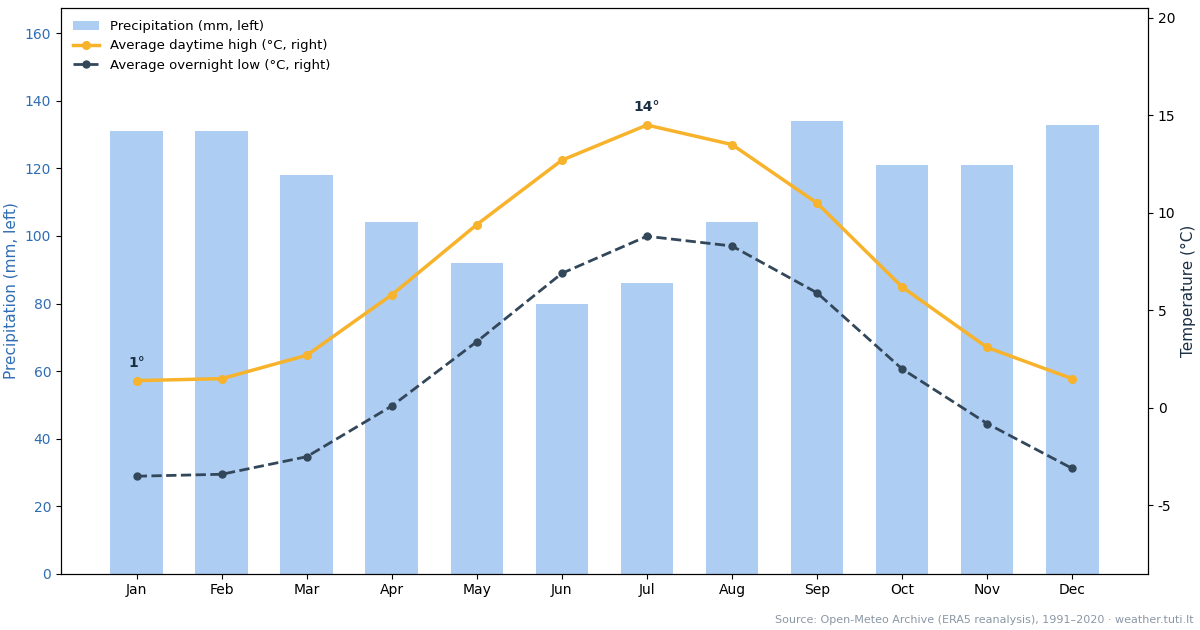
| Month | Avg. daytime high | Avg. overnight low | Avg. precipitation | Days with ≥1 mm | Daylight |
|---|---|---|---|---|---|
| January | 1.4 °C | -3.5 °C | 131 mm | 58% | 5.6 h |
| February | 1.5 °C | -3.4 °C | 131 mm | 60% | 8.6 h |
| March | 2.7 °C | -2.5 °C | 118 mm | 55% | 11.8 h |
| April | 5.8 °C | 0.1 °C | 104 mm | 55% | 15.1 h |
| May | 9.4 °C | 3.4 °C | 92 mm | 51% | 18.5 h |
| June | 12.7 °C | 6.9 °C | 80 mm | 48% | 20.8 h |
| July | 14.5 °C | 8.8 °C | 86 mm | 48% | 19.5 h |
| August | 13.5 °C | 8.3 °C | 104 mm | 51% | 16.3 h |
| September | 10.5 °C | 5.9 °C | 134 mm | 59% | 13.0 h |
| October | 6.2 °C | 2.0 °C | 121 mm | 48% | 9.7 h |
| November | 3.1 °C | -0.8 °C | 121 mm | 55% | 6.5 h |
| December | 1.5 °C | -3.1 °C | 133 mm | 57% | 4.4 h |
Gulf Stream mild, North Atlantic wild
Reykjavík sits at 64°N — the latitude of Arctic Greenland — yet January's average high is a surprising 1.4 °C, thanks to the North Atlantic Current. What the ocean moderates in temperature, it spends in wind and weather: Atlantic lows parade across the island year-round, so the weather changes by the hour and the wind chill, not the thermometer, is what you dress for.
Annual precipitation averages about 1355.0 mm, wet days roughly 54% of the year — but the same day can deliver sun, hail, a rainbow and a 70 km/h gust. The Icelandic Met Office's colour-coded wind warnings are a genuine travel tool; check them alongside the hourly forecast.
June to August: the endless day
Summer is the season the ring road was built for: July averages 14.5 °C by day (13.5 °C in August), and June's daylight runs about 20.8 hours — the sun barely sets at solstice and the 'night' is a long golden dusk. All interior roads (the F-roads) and mountain passes open, Puffin season runs, and every tour operator is at full capacity.
Pack as if for changeable autumn anywhere: showers and gusts arrive in any month (86 mm in July), and a 12 °C afternoon with wind feels colder than the number. The reward is Iceland's greenest, most open version — and the midnight sun on a clear evening is a genuine life-list item.
September to November: the lights return
From late August the nights darken enough for aurora, and September–October balance dark skies with still-long days (13.0 h in September) and relatively stable shoulder-season weather (134 mm, 121 mm). The landscape turns rust-gold, the crowds thin, and the first serious storms announce winter.
This is the sweet spot for aurora-first trips: statistically decent geomagnetic season, drivable roads, and daylight enough to see the waterfalls between the dark-sky vigils.
December to February: dark, bright and icy
Deep winter is dark — December averages 4.4 hours of daylight — and stormy, with highs of 1.5 °C and lows of -3.1 °C in Reykjavík while the north and highlands freeze harder. Yet it is a real travel season: the Christmas city lights, ice caves under the glaciers (guides only), and aurora nights that the darkness makes routine rather than lucky.
The honest caveat: winter storms can close roads and cancel tours for a day at a time — build slack into any January itinerary and treat the forecast as a daily contract.
March to May: still winter, then suddenly spring
March (2.7 °C) is a locals' favourite: winter light returning (11.8 hours), aurora still active, snow activities running. April (5.8 °C) and May (9.4 °C) swing toward spring — drier by March standards is not saying much, but daylight rockets and the first puffins arrive late April.
So, when should you go?
- Ring road and highlands: July–early September — open roads, endless light, full services.
- Northern lights: late September–March, with September–October and March the easiest all-round months.
- Ice caves and winter drama: December–February — dark, stormy, spectacular; book flexible tours.
- Coolcation crowd-dodgers: June for the sun, September for the quiet — see the trends piece.