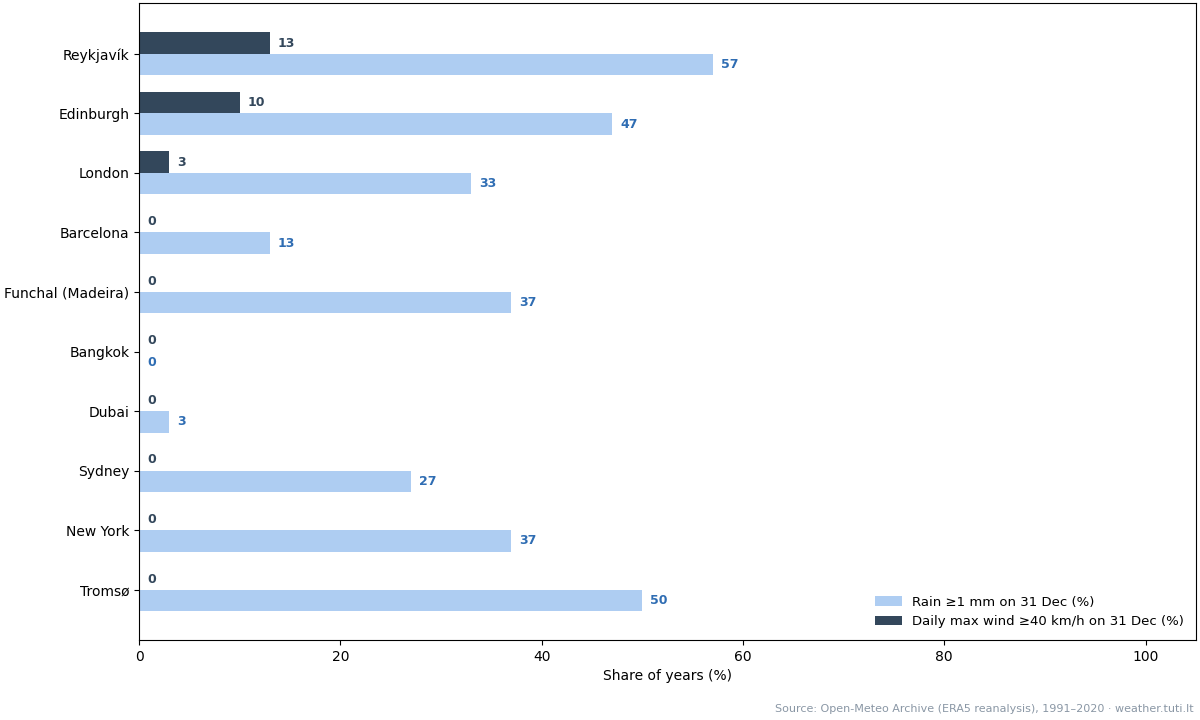
Read the table as follows: rain years are those with at least 1 mm of precipitation on 31 December; blustery years are those with a daily maximum wind of 40 km/h or more (the level where organised displays start watching their roofs, though actual cancellation thresholds are stricter and site-specific); the evening temperature is the average overnight low of the following 1 January — a proxy for how midnight feels.
| City | Rain on 31 Dec | Blustery (max wind ≥40 km/h) | Avg. max wind | Evening temperature* |
|---|---|---|---|---|
| London, UK | 33% | 3% | 22.0 km/h | 2.4 °C |
| Edinburgh, Scotland | 47% | 10% | 26.0 km/h | 2.0 °C |
| Reykjavík, Iceland | 57% | 13% | 24.0 km/h | -4.5 °C |
| Tromsø, Norway | 50% | 0% | 15.0 km/h | -11.1 °C |
| New York, USA | 37% | 0% | 18.0 km/h | -3.8 °C |
| Sydney, Australia | 27% | 0% | 19.0 km/h | 19.1 °C |
| Dubai, UAE | 3% | 0% | 17.0 km/h | 14.5 °C |
| Bangkok, Thailand | 0% | 0% | 13.0 km/h | 20.8 °C |
| Funchal, Madeira | 37% | 0% | 15.0 km/h | 15.9 °C |
| Barcelona, Spain | 13% | 0% | 14.0 km/h | 5.4 °C |
What actually cancels a fireworks show
Wind, not rain, is the professional fireworks crew's enemy: strong gusts misalign mortar angles, carry embers and make rooftop and barge platforms unsafe — which is why cities publish wind thresholds and cancel in steps rather than at the first drizzle. Rain mostly affects the crowd's comfort, not the pyrotechnics.
Our blustery index (daily maximum wind of 40 km/h or more on 31 December) is therefore the column to watch for 'will it go ahead?' risk, and the rain column is the one to watch for 'will I be miserable standing in it?' risk.
The dry and the mild: Dubai, Bangkok, Funchal, Barcelona
Dubai's countdown sits squarely in the desert dry season: rain on New Year's Eve is a curiosity (3% of years), evening air runs 14.5 °C, and the only real variable is haze. Bangkok's Chao Phraya countdown is similar — 0% rain years and 20.8 °C at midnight, safely inside the cool season (see the Thailand guide).
Funchal combines the two — Madeira's New Year fireworks over Funchal bay are famous, and the island's subtropical climate delivers 37% rain years with 15.9 °C evenings. Barcelona offers the European mild option: 13% rain years and 5.4 °C evenings, with the beach-side countdown as a fallback to any cancelled show.
The blustery north: Edinburgh, Reykjavík and Tromsø
Edinburgh's Hogmanay street party is the British winter's big night, and the data says the wind risk is real (10% of years hit the 40 km/h mark, averaging 26.0 km/h max wind) — Highland weather on a hill city. Rain arrives in 47% of years. The party rarely cancels; the sensible kit is windproof, not merely waterproof.
Reykjavík tops the wind table (13%, average max 24.0 km/h): the New Year bonfires and amateur fireworks survive the North Atlantic routinely, but a calm, clear midnight — the kind that makes the aurora visible — is the jackpot, not the default. Tromsø swaps fireworks risk for certainty of darkness (-11.1 °C evenings): the polar night means a midnight sky at noon-dark, which is why the northern-lights chase replaces the pyrotechnics there.
The classics: London and New York
London's Thames display runs 33% rain years and 3% blustery years, with 2.4 °C evenings — the usual British winter package, managed with riverside ticketing since the crowds outgrew the banks. New York's Times Square has a similar profile (37% rain, 0% windy, -3.8 °C evenings): the cold is the memorable part, and the 1991–2020 record includes the brutal ones.
For both, the decision tool is the same as for any winter trip: book for the event, dress for the median, and use the live forecast in the final 72 hours — the week-ahead strip will tell you which column your year lands in.