Read the table as follows: the daytime high is the average of all daily maximums for that month across 1991–2020, the overnight low the average of all daily minimums, and the wet-day share the fraction of days with at least 1 mm. For the week ahead, use the live Rome forecast.
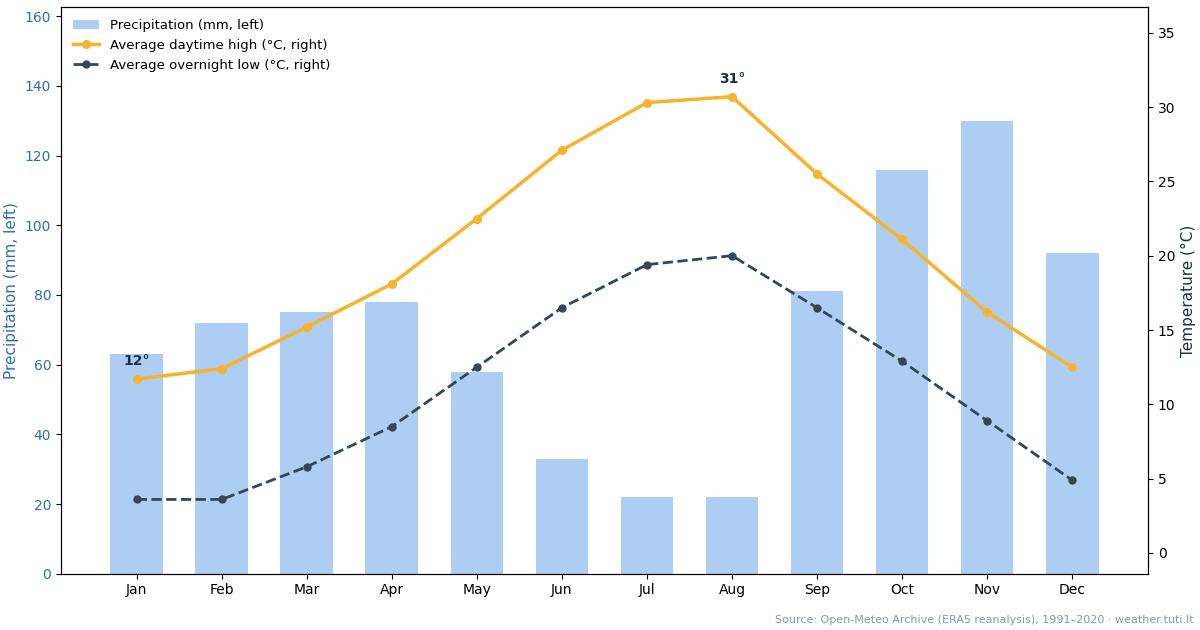
| Month | Avg. daytime high | Avg. overnight low | Avg. precipitation | Days with ≥1 mm | Daylight |
|---|---|---|---|---|---|
| January | 11.7 °C | 3.6 °C | 63 mm | 28% | 9.5 h |
| February | 12.4 °C | 3.6 °C | 72 mm | 32% | 10.6 h |
| March | 15.2 °C | 5.8 °C | 75 mm | 30% | 12.0 h |
| April | 18.1 °C | 8.5 °C | 78 mm | 35% | 13.4 h |
| May | 22.5 °C | 12.5 °C | 58 mm | 28% | 14.6 h |
| June | 27.1 °C | 16.5 °C | 33 mm | 18% | 15.2 h |
| July | 30.3 °C | 19.4 °C | 22 mm | 13% | 14.9 h |
| August | 30.7 °C | 20.0 °C | 22 mm | 14% | 13.8 h |
| September | 25.5 °C | 16.5 °C | 81 mm | 30% | 12.5 h |
| October | 21.1 °C | 12.9 °C | 116 mm | 34% | 11.1 h |
| November | 16.2 °C | 8.9 °C | 130 mm | 41% | 9.8 h |
| December | 12.5 °C | 4.9 °C | 92 mm | 34% | 9.2 h |
A city built for shoulder seasons
Rome's climate is Mediterranean with a continental temper: hot, dry summers; mild, bright winters; and rainy seasons at the shoulders (especially November). The city's stone — travertine, marble, cobbles — stores summer heat and releases it into the evening, which is why a Roman August night can feel as warm as the afternoon.
The practical reading of the table: spring and autumn are for walking the city; summer is for early mornings, long lunches and evening passeggiata; winter is for museums and bargains.
April to June: the city outdoors
April opens the walking season (18.1 °C average highs, 78 mm of rain), May warms to 22.5 °C, and June reaches 27.1 °C with daylight past 15.2 hours. The parks — Villa Borghese, the Orange Garden, the Appian Way — are at their greenest, and the fountains are still cold enough to be an amenity.
Book the big sites (Colosseum, Vatican) ahead in this stretch; it is high season for a reason.
July and August: the Roman summer
July averages 30.3 °C and August 30.7 °C, with overnight lows near 19.4 °C and rain almost absent (22 mm). Heat reflects off the piazze at midday; the locals' rhythm — errands at seven, shade at one, dinner at nine — is the survival guide.
August adds a cultural quirk: the ferragosto break, when many Romans leave and some family-run shops and trattorie close. Monuments stay open, and for some travellers the emptier city is worth the heat — but plan mornings, use the hourly strip, and book a hotel with air conditioning rather than a promise.
September and October: golden Rome
September is the second-best month of the Roman year: 25.5 °C average highs, warm evenings, the summer crowds thinned. October (21.1 °C) turns golden and cooler with the first autumn fronts (116 mm); November brings the year's rain peak (130 mm) — pack a shell, not necessarily an umbrella of dignity.
For food travellers these months carry the harvest menus, and the light on the travertine at five in the afternoon justifies the whole trip.
November to March: quiet, mild, cheap
Winter is Rome's quiet secret: highs of 12.5 °C in December, 11.7 °C in January and 12.4 °C in February, with rain the main planning item (130 mm in November, easing into the new year). Frost is rare; snow is a novelty the city photographs beautifully when it happens.
Museum queues shrink, hotel prices drop, and Christmas lights fill the trastevere lanes. For a first trip focused on galleries and food rather than terraces, winter is a genuine strategy — with the week-ahead forecast as the umbrella scheduler.
So, when should you go?
- First visit, walking the city: April–May or September–October — warm, open, civilised.
- Budget traveller: November–February — the cheapest rooms and shortest queues; bring rain gear for November.
- Summer visitor: July–August with Roman hours — early sites, shaded lunch, late dinners.
- Pairing with the coast: see the Amalfi Coast guide — Rome feeds it by train.