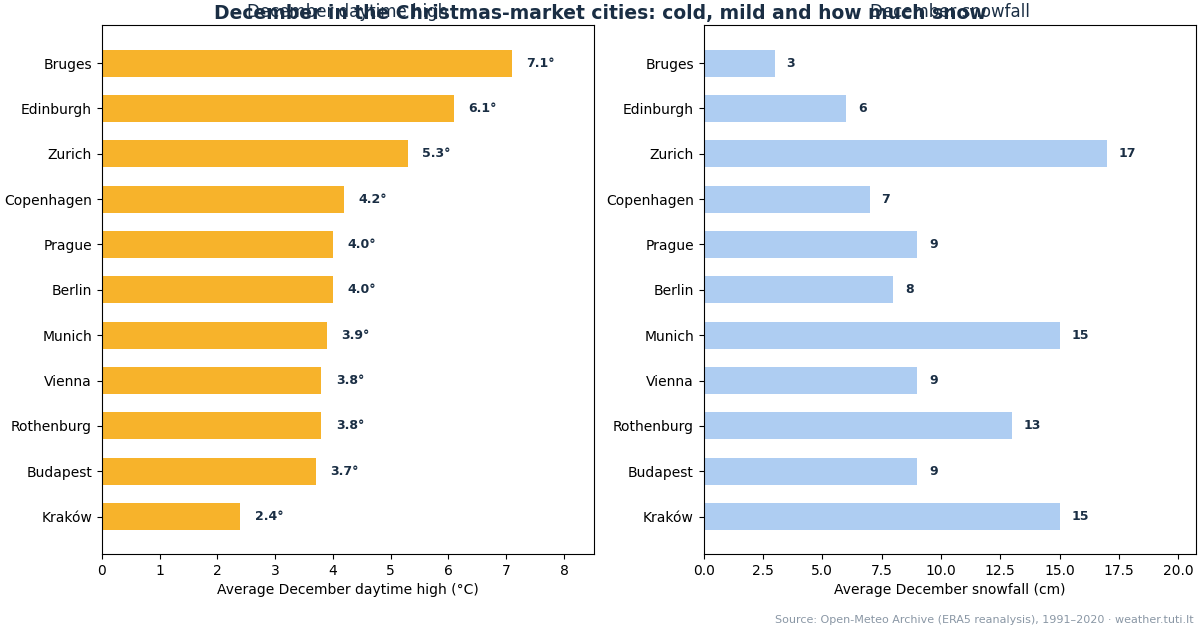
Read the table as follows: December averages across 1991–2020 from daily reanalysis data — the daytime high and overnight low frame the hours you will actually stand outside (markets run roughly 10:00–21:00, i.e. through the falling afternoon), rain is the monthly total with wet days its share, and snowfall is the average December accumulation in cm of fresh snow.
| City | Avg. December high | Avg. December low | Avg. rain | Wet days | Avg. snowfall |
|---|---|---|---|---|---|
| Vienna, Austria | 3.8 °C | -1.8 °C | 39.0 mm | 29% | 9.0 cm |
| Munich, Germany | 3.9 °C | -2.4 °C | 67.0 mm | 41% | 15.0 cm |
| Prague, Czechia | 4.0 °C | -1.2 °C | 40.0 mm | 31% | 9.0 cm |
| Kraków, Poland | 2.4 °C | -3.2 °C | 41.0 mm | 32% | 15.0 cm |
| Budapest, Hungary | 3.7 °C | -1.9 °C | 44.0 mm | 27% | 9.0 cm |
| Berlin, Germany | 4.0 °C | -0.3 °C | 46.0 mm | 36% | 8.0 cm |
| Zurich, Switzerland | 5.3 °C | -0.5 °C | 92.0 mm | 44% | 17.0 cm |
| Rothenburg, Germany | 3.8 °C | -0.8 °C | 70.0 mm | 43% | 13.0 cm |
| Copenhagen, Denmark | 4.2 °C | 0.9 °C | 54.0 mm | 38% | 7.0 cm |
| Edinburgh, Scotland | 6.1 °C | 2.0 °C | 77.0 mm | 44% | 6.0 cm |
| Bruges, Belgium | 7.1 °C | 3.2 °C | 74.0 mm | 45% | 3.0 cm |
How to read December numbers as a market-goer
Market hours straddle the day's temperature collapse: stalls open in the afternoon high and do their best business after dark, when the temperature sits between the day's high and the night's low. A city with a 3 °C high and a −2 °C low delivers a −1 °C evening stroll; a city with an 8 °C high and 4 °C low never feels properly wintry.
Snow does the scenery's heavy lifting but rain does the discomfort: two cities can share a temperature profile while one collects most of its December moisture as snow and the other as drizzle. That is the real ranking axis.
The cold-and-snowy classics: Kraków, Munich, Prague, Vienna, Budapest, Berlin
Kraków is the deep-winter pick: 2.4 °C December highs, -3.2 °C lows, and 15.0 cm of December snow — the market square under real snow is a genuine probability, not a poster. Munich (15.0 cm) and Berlin (8.0 cm) run the same German cold with slightly milder averages (3.9 °C and 4.0 °C highs).
Vienna (3.8 °C, 9.0 cm) and Budapest (3.7 °C, 9.0 cm) trade a degree or two of cold for the grandest backdrops — the Rathausplatz and the Parliament respectively — while Prague (4.0 °C, 9.0 cm) delivers the medieval square version of the same climate. All six frost hard after dark (-3.2 °C to -1.9 °C average lows): the mulled wine is functional, not decorative.
The milder Atlantic markets: Edinburgh, Copenhagen, Bruges, Zurich, Rothenburg
Edinburgh (6.1 °C, 6.0 cm of snow but 44% wet days) and Copenhagen (4.2 °C, 38% wet days) offer maritime winters: festive, breezy, occasionally frosty — rarely snowy. Bruges (7.1 °C, 3.0 cm) is Europe's mildest famous market, and leans into it: chocolate, lights and canals instead of frost (city guide).
Zurich (5.3 °C, 17.0 cm) is the Swiss surprise — milder than Munich by a degree yet the snowiest December of the table — and Rothenburg (3.8 °C, 13.0 cm) remains the small-town specialist: its Reiterlesmarkt packs the medieval-winter experience into a walled town where frost does the scenery work snow sometimes skips.
Building a market trip around the weather
- Maximum winter drama: Kraków or Munich — coldest and snowiest of the classics; pack Arctic-grade layers (see the winter-arrival calendar for why late December is their reliable zone).
- Best scenery-per-degree: Vienna or Prague — real chill, huge market density, rail-linkable.
- Mild-weather market trip: Bruges or Edinburgh — pack rain shell instead of parka.
- Snow-lottery players: check the white-Christmas index before choosing your dates.