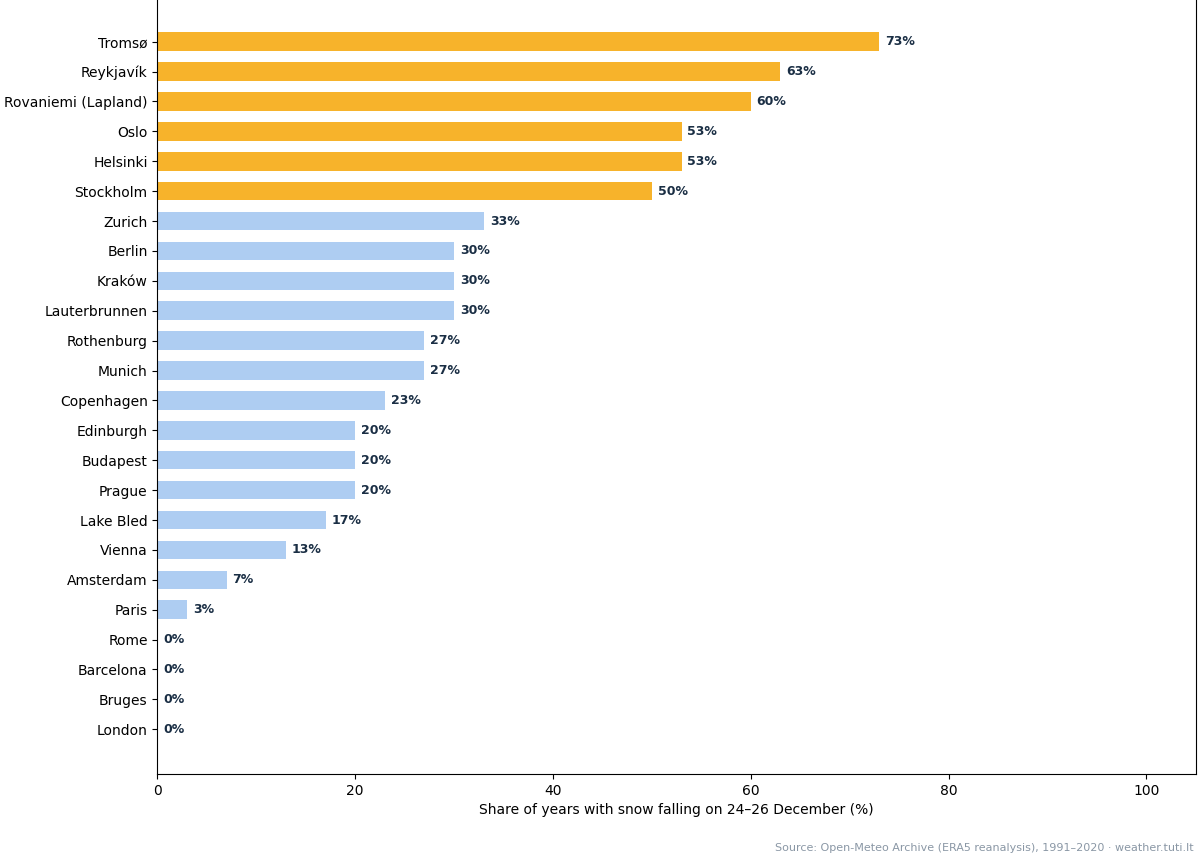
Read the table as follows: the first column is the share of years (1991–2020) in which at least 1 cm of snow fell on any of 24, 25 or 26 December; the second is the share of years in which Christmas Day's average daytime high stayed at or below 0 °C — a 'frozen' Christmas even without snow. Both are computed from daily reanalysis data.
| City | Snow falling on 24–26 December | "Frozen" Christmas Day (high ≤0 °C) | Avg. December daytime high |
|---|---|---|---|
| Tromsø, Norway | 73% | 67% | -3.9 °C |
| Rovaniemi, Finland | 60% | 80% | -4.8 °C |
| Reykjavík, Iceland | 63% | 37% | 1.5 °C |
| Helsinki, Finland | 53% | 57% | 0.2 °C |
| Oslo, Norway | 53% | 43% | -0.2 °C |
| Stockholm, Sweden | 50% | 27% | 1.9 °C |
| Lauterbrunnen, Switzerland | 30% | 10% | 4.1 °C |
| Munich, Germany | 27% | 10% | 3.9 °C |
| Zurich, Switzerland | 33% | 7% | 5.3 °C |
| Vienna, Austria | 13% | 27% | 3.8 °C |
| Prague, Czechia | 20% | 17% | 4.0 °C |
| Kraków, Poland | 30% | 30% | 2.4 °C |
| Budapest, Hungary | 20% | 27% | 3.7 °C |
| Rothenburg, Germany | 27% | 10% | 3.8 °C |
| Berlin, Germany | 30% | 20% | 4.0 °C |
| Copenhagen, Denmark | 23% | 23% | 4.2 °C |
| Lake Bled, Slovenia | 17% | 10% | 4.6 °C |
| Edinburgh, Scotland | 20% | 3% | 6.1 °C |
| Amsterdam, Netherlands | 7% | 0% | 6.4 °C |
| London, UK | 0% | 3% | 7.7 °C |
| Paris, France | 3% | 10% | 7.5 °C |
| Bruges, Belgium | 0% | 0% | 7.1 °C |
| Barcelona, Spain | 0% | 0% | 13.3 °C |
| Rome, Italy | 0% | 0% | 12.5 °C |
What the index measures — and what it doesn't
Two definitions of 'white Christmas' exist, and they are not the same. Ours counts snowfall: at least 1 cm of snow falling during the three-day window of 24–26 December. It does not count snow already lying on the ground from earlier falls — which is the definition some weather services use, and which is kinder to northern cities because snow that fell on 20 December still counts on the 25th.
The distinction matters most in the maritime cities: a cold snap in early December can whiten London or Copenhagen for a week and then melt before the holiday. The falling-snow index is the stricter, more cinematic test — snow in the air on the day itself.
The closest thing to a guarantee: Lapland and the Arctic
At 66°N, Rovaniemi's December runs at an average daytime high of -4.8 °C and an overnight low of -10.2 °C, with snow on the ground continuously from October — the Arctic Circle 'Santa Claus' town is the one destination where snow underfoot is the default and flakes in the air land in 60% of years. Tromsø, 350 km further north, does even better on snow (73%) and trades daylight for it: the polar night means the sun does not rise at all in late December.
Reykjavík sits at 63% — high, but not certain, because Atlantic warmth keeps intruding; Icelandic Christmases alternate between deep snow and green rain. For a guaranteed white holiday, the Arctic winnows the choice to Lapland (see the Lapland trip guide).
The coin-flip band: the Nordic and Alpine capitals
Helsinki (53%), Oslo (53%) and Stockholm (50%) are the honest middle: Christmas snow falls roughly every second year, and cold snaps are frequent enough that a frozen Christmas (57% and 27% frozen shares) is a live possibility. Zurich (33%) rides the same band thanks to its altitude, though the city itself sits lower than the Alps that surround it.
In the Alps proper, the Lauterbrunnen valley shows 30% — high for a valley floor at 800 m; the ski villages above it (Wengen, Mürren, Grindelwald) live in a snowier version of the same climate (valley guide).
Central Europe: real chances, not promises
Munich (27%), Prague (20%), Kraków (30%), Vienna (13%), Budapest (20%) and Rothenburg (27%) form the classic Christmas-postcard band: cold enough for snow to fall on the holiday in roughly one year out of three or four, cold enough for frozen days occasionally, and near-certain seasonal ambience — frost, mulled-wine steam, dark afternoons — even when the snow misses.
If a snowy market stroll is the goal, the practical play is to book one of these cities for the season and treat snow as a bonus: the Christmas-market weather ranking compares their December numbers in detail.
The long shots: the maritime and Mediterranean cities
London (0%) and Bruges (0%) sit closest to the sea and to the westerly flow: in thirty years of the reanalysis grid, not a single Christmas window produced falling snow. Amsterdam (7%) and Paris (3%) are once-a-decade events, and Copenhagen (23%) a minority one. Edinburgh (20%) earns its frosty image more from gales than from flakes.
And the Mediterranean never really plays: Rome (0%) and Barcelona (0%) had snowfall in the Christmas window in essentially none of thirty years — the last widespread Rome Christmas snow made headlines precisely because of its rarity. For guaranteed winter atmosphere in these cities, plan on Christmas lights and mild air, not flakes; for guaranteed winter sun instead, see the winter-sun comparison.